he essence of this post is that 1267 nm near infrared light (NIR) activates clearance of particles from mouse brains via the generation of the weakly reactive oxygen species singlet oxygen. This model is consistent with what we know about lymphatic vessel pulsing and singlet oxygen modifications to contractile proteins. The bigger question is if NIR can clear microplastics from human brains and if the frequency of red light pulsing needs to be in harmony with lymphatic vessel pulsing.
Lymphatic Clearance and Pump Function
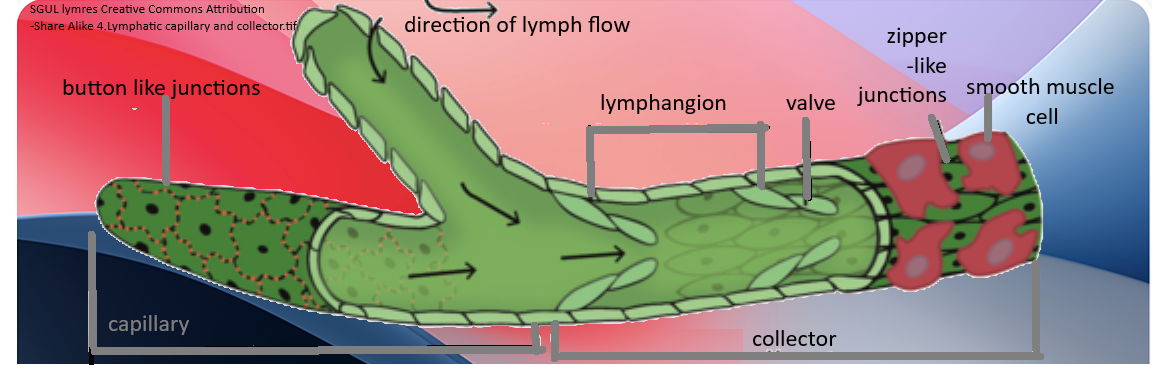
The Breslin 2023 review is one of many addressing lymphatic vessel function. This publication has many very nice cartoons that say a lot. Let’s take a journey through some remarkable illustrations on how lymphatic vessels pump and why it matters for red light therapy.
Fig 1 Most of us remember capillaries connecting venules and arterioles that feed into larger blood vessels. Lymphatic capillaries are blind ended and simply drain fluid from tissue. We see our first valve in the capillaries that feed into a pre- collector that lacks smooth muscle (a likely target for red light).
Fig 2 Now we get into smooth muscle cells as we move from draining fluid from tissue to taking it somewhere. The cartoon lists some protein markers that are not important for our story.
Fig 3 Things start to get very complicated when we move further up to lymphatic vessels are enough to feel pressure changes with the cardiac cycle. The valves complicate pressure changes further. Contraction and relaxation are dependent on pressure and electrical signals.
Fig 4 Ryanodine receptors are actually channels that release Ca2+ from intracellular stores. They are coupled to the opening of L-type voltage gated Ca2+ channels. Ca2+ is returned to the intracellular stores by the sarcoplasmic-endoplasmic-Ca2+-ATPase. This figure correlates Ca2+ transients with changes in vessel diameter (contraction).The letting Ca2+ out and putting it back in constitutes some element of pace making activity. The PEMF and constipation post touches upon other ion channels that contribute to pace making. Ano1 was also mentioned in the Breslin 2023 review. Note: It makes absolutely no sense whatsoever to activate lymph flow with static red/NIR light.
Fig 5 Peptides can cause our blood vessels to contract or relax. So it is with lymphatic vessels. Some of these are G-protein coupled receptors that fire through RhoA operated C kinase (ROCK). Link to a good cartoon illustrating how this Ca2+ – independent pathway leads to smooth muscle contraction. Breslin 2023 claim that lymphatic vessels contain not only a smooth muscle isoform of myosin heavy chain that is regulated by ROCK/ myosin light chain kinase, but also a cardiac isoform of myosin and some of the regulatory proteins troponin I and C. They did not mention troponin T and tropomyosin. This YouTube video on striated muscle contraction speaks to how interesting these findings re. Fig 5 of Breslin indicates pace maker activity when ROCK is inhibited. At 3:09 minutes ROCK comes into this smooth muscle contraction YouTube video. The yellow myosin light chain phosphatase PAC man at 2:00 minutes is activated by phosphorylation by protein kinase G, which is activated by cyclic GMP whose production is elicited by nitric oxide. This brings us to the use of 1267 nm NIR to activate lymphatic vessel flow. It’s all about nitric oxide. The pesky possibility that cardiac properties of lymphatic vessels might be stirring in the background.

1267 nm near intrared light, getting lymphatics to punp
In a 2020 study Semyachkina-Glushkovskaya and coauthors established the optimal laser power to move florescent labeled dextran in small intestine mesenteric lymph vessels (MLV). Fig 1 of the 2020 publication gives some nice visuals. Panel VII shows the clearance of fluorescent probe FITC-dextran (green color) from the brain via LVs (blue color), which are located close to the cerebral veins (red color, labeled by NG2).
A year later in 2021 Semyachkina-Glushkovskaya and others took the concept to a more clinical level. They created Alzheimer’s Disease in mice by injection of Aβ (1-42) peptide (1 μL, 200 μmol) in the CA1 field of the hippocampus. The mice were given three days to recover from surgery after which a laser diode emitting at 1267 nm (32 J/cm2) therapy was started. Every second day 61 minute treatments consisting of 17 min – irradiation with 5 min pauses were given. Fig 1 shows slight and statistically significant clearance of beta amyloids and the meningeal lymph vessels responsible for the removal of the peptides. We do not know how much Aβ peptides aggregated. Whether this clearance is functionally significant is an other matter.
In 2023 Semyachkina-Glushkovskaya and others in the group published more results using a 1267 nm laser. They used the same fluorescent probe FITC attached to 70 kD dextran. FITCD was injected into the right lateral ventricle. They finally told their readers that the use of 1267 nm was for the generation of singlet oxygen. Fig 1 of 2023 requires more explanation than given in the publication. Mechanisms of the photo stimulation (PS) effects on the lymph vessels (LV). As in previous publications a red fluorescent probe was used to detect CD31, an endothelial cell marker. Endothelial cells are found on blood and lymphatic vessels. The goal was to monitor FITC-detran to deep cervical lymph nodes dcLN. The images of this study are spectacular with the usual issues with FITC fluorescence that include “self quenching” when concentrations become too high.
- a. A dorsal/top view of the brain without PS.
- b. A ventral/bottom view of the brain without PS. This one looks vaguely like the Circle of Willis with the basilar artery on the left
- c. Appears to be whole brain images. Remember that the FITC detran is green, where they injected.
- d. Another top view this time after photo stimulation.
- e. Another top view this time after photo stimulation, we can really see movement.
- f. A whole brain image, we can really see FITC-D movement.
- g-h We are seeing more FITC fluorescence after photostimulation.
- i. The weak and strong contractions were measured in mesenteric lymphangion of the small intestine.
- j. Nitric oxide is a short lived molecule. It rapidly decays to nitrite (NO2) and nitrate (NO3) Also note that these are lymph node endothelial cells.
- k-l. Here the authors are using a cell culture blood brain barrier model. Dihydroethidium is colorless until it reacts with super oxide and other reactive oxygen species. Once reacted, it absorbs in the blue region of the spectrum and fluoresces in the red region.
- m. Putting numbers to images in panels K-L. NIR and singlet 1O2
A minor flaw in this otherwise nice study is that dihydroethidium might have been reacting to superoxide from the mitochondria exposed to NIR. The 1267 nm could have been releasing bound NO completely independent of superoxide from the mitochondria and singlet oxygen. Intracellular Ca2+ would have been nice in a world of unlimited financial resources. With these caveats, this was a very nice study worthy of exploring other publications that back up the claims.
1267 nm NIR, generator of singlet oxygen
Quoting directly from a Makovik 2023 PubMed abstract
“This work investigates the influence of laser irradiation parameters (wavelength, power density and exposure time) on singlet oxygen (1O2) generation efficiency. Chemical trap (L-histidine) and fluorescent probe (Singlet Oxygen Sensor Green, SOSG) detection methods were used. Studies have been conducted for 1267, 1244, 1122 and 1064 nm laser wavelengths. 1267 nm had the highest efficiency of 1O2 generation, but 1064 nm demonstrated almost the same efficiency. We also observed that the 1244 nm wavelength can generate some amount of 1O2. It was demonstrated that laser exposure time can generate 1O2 more efficiently than an increase of power. Additionally, the SOSG fluorescence intensity measurements method for acute brain slices was studied. This allowed us to evaluate the approach’s potential for in vivo detection of 1O2 concentrations. “
Lumiprobe has a cartoon of how 1O2 interacts with a polyaromatic compound. Note that this method is distinct and more specific than the use of dihydoethidium.
The singlet 1O2 NO° connection
Absolutely nothing was found on PubMed suggesting that this reaction proceeds faster with singlet 1O2 rather than the normal triple oxygen 3O2.
2 L-arginine + 3 NADPH + 3 H+ + 4 O2 ⇌ 2 citrulline +2 nitric oxide + 4 H2O + 3 NADP+ 3NADP+
Yan 2006 used a totally different system to generate 1O2 to test the hypothesis that1O2 will produce new protein oxidations. Quoting from their abstract:
“identified light-dependent oxidative modifications of endogenous methionines to their corresponding methionine sulfoxides. Initial rates of methionine oxidation correlate with surface accessibility and are insensitive to the distance between the bound fluorophore and individual methionines, which vary between ∼7 and 40 Å. In addition, we observed a loss of histidines, as well as zero-length cross-linking with binding partners corresponding to the CaM-binding sites of smooth myosin light chain kinase and ryanodine receptor. Our results provide a rationale for proteomic screens using FALI to inhibit the function of many signaling proteins, which, like CaM, commonly present methionines at binding interfaces.”
The ryanodine receptor was discussed in terms of pumping activity of lymphatic vessels. It should be noted that nitric oxide synthases are also calmodulin binding proteins. Click here for a cartoon summary.
Moving forward on brain detox
- Good evidence suggests that 1237 and 1064 nm NIR can generate singlet O2. Madovik 2023
- 1O2 can result in modifications to proteins (Yan 2006) involved in lymphatic vessel pulsing (Breslin 2023)
- Semyachkina-Glushkovskaya 2023 demonstrated likely involvement of 1O2 generated from 12367 nm NIR light in the clearance dextran particles from mouse brain. Would 1267nm or 1064nm NIR light clear microplastics that have recently been found in deceased human brains in a manner that correlates with dementia? See report in the Smithsonian.
Red Light Therapy Home Pulsing
Total Spectrum devices allow for customizable pulsing up to 5,000 Hz, so you could experiment with lower frequencies (e.g., 10-40 Hz) in the Mental Health & Brain mode, which emphasizes NIR and Deep NIR wavelengths (810-1064 nm) that penetrate deeper into tissues like the brain. Start with 10-15 minutes at 1-2 feet away, eyes closed and protected, perhaps in the evening to support overnight glymphatic clearance during sleep. If you’re addressing brain detox specifically, combining this with hydration and movement could amplify benefits – always consult a healthcare professional for personalized advice, of course.
If you would like to order your own red light therapy device from Red Light Therapy Home, use this promo code for a 6% discount
Friend6-ZQDGW49R
References
- Breslin JW. Lymphatic Clearance and Pump Function. Cold Spring Harb Perspect Med. 2023 Feb 1;13(2):a041187. PMC free paper
- Makovik I, Vinokurov A, Dunaev A, Rafailov E, Dremin V. Efficiency of direct photoinduced generation of singlet oxygen at different wavelengths, power density and exposure time of laser irradiation. Analyst. 2023 Jul 26;148(15):3559-3564. PubMed
- Semyachkina-Glushkovskaya O, Abdurashitov A, Dubrovsky A, Klimova M, Agranovich I, Terskov A, Shirokov A, Vinnik V, Kuzmina A, Lezhnev N, Blokhina I, Shnitenkova A, Tuchin V, Rafailov E, Kurths J. Photobiomodulation of lymphatic drainage and clearance: perspective strategy for augmentation of meningeal lymphatic functions. Biomed Opt Express. 2020 Jan 10;11(2):725-734. PMC free paper
- Semyachkina-Glushkovskaya O., Klimova M., Iskra T., Bragin D., Abdurashitov A., Dubrovsky A., Khorovodov A., Terskov A., Blokhina I., Lezhnev N., et al. Transcranial Photobiomodulation of Clearance of Beta-Amyloid from the Mouse Brain: Effects on the Meningeal Lymphatic Drainage and Blood Oxygen Saturation of the Brain. Adv. Exp. Med. Biol. 2021;1269:57–61. [PMC free article]
- Semyachkina-Glushkovskaya O, Bragin D, Fedosov I, Blokhina I, Khorovodov A, Terskov A, Shirokov A, Dubrovsky A, Vinnik V, Evsukova A, Elovenko D, Adushkina V, Tzoy M, Dmitrenko A, Krupnova V, Manzhaeva M, Agranovich I, Saranceva E, Iskra T, Lykova E, Sokolovski S, Rafailov E, Kurths J. Mechanisms of Photostimulation of Brain’s Waste Disposal System: The Role of Singlet Oxygen. Adv Exp Med Biol. 2023;1438:45-50. PMC free paper
- Yan P, Xiong Y, Chen B, Negash S, Squier TC, Mayer MU. Fluorophore-assisted light inactivation of calmodulin involves singlet-oxygen mediated cross-linking and methionine oxidation. Biochemistry. 2006 Apr 18;45(15):4736-48… PubMed
Leave a Reply