Some elemental toxins are not what we’d consider “heavy metals” even if they are metallic in nature when in the +0 charge state. I pieced this figure together from a Periodic Table of the Elements on Wikimedia commons. Ca2+, Na+, and Mn2+ are mentioned a lot in the papers I’m going to briefly mention. Ca2+ and Na+are alkali earth metals having an S-shell with zero to two electrons depending on the charge state. The underlying electron shells are full and not available for bonding. Our heavy metal friends Manganese, cadmium, and mercury are legitimate heavy metals with vacant d-shell spaces for bonding electrons with materials such as alginate. Uranium forms bonds with outer f-shell electrons and has slightly more diverse commonly found charge/oxidation states. Then we get to the P-block elemental toxins with diverse charge states that are just a little bit more complicated than Ca2+. Ca2+ does not form covalent bonds with alginate anyway, just some “opposites attract” ionic bonds [1].
Magnified elements of interest to this post

To make things complete, the entire Periodic Table.

Alkali earths vs Transition metals [1]
Alginate is a polysaccharide of (1→4) linked α-L-guluronate(G) and β-D-mannuronate (M), a naturalcopolymer in the brown seaweeds with a nonregular block-wise arrangement between the G and M units. In this computational study, that there is only electrostatic interaction in the alkaline-earth (AE) cations were shown unambiguously to form ionic bonds with uronate units, whereas the transition metal TM cations formed strong covalent-coordination bonds. Density Functional Theory used in this study,
- Ca2+, Mg2+, Sr2+ interactions occur without any overlap between oxygen molecular orbitals.
- Mn2+, Co2+, Cu2+ and Zn2+ are bound with the contribution of strong coordination covalent bonds.
This study also indicated that the binding strength does not limit alginate gelation in the presence of either type of cations. The P-series were not investigated.
Looking at molecular orbitals
This image came from Wikipedia Commons, with citations as indicated. Ca2+ and Na+ have just s shell outer valance electrons and a spherical configuration. Going to the P Block elements we have more options of electron probability clouds which are exactly that: where we are most likely to bind bonding electrons. We learned in school that carbon can form up to four bods, nitrogen three, and oxygen just two covalent bonds. Fluorine can form just one covalent bond, and neon zero. When we move to transition metals in the D Block things are considerably more complicated as to where electrons like to hang out around their nucleus and around the nucleus of others atoms that participate in covalent bonds with.
.

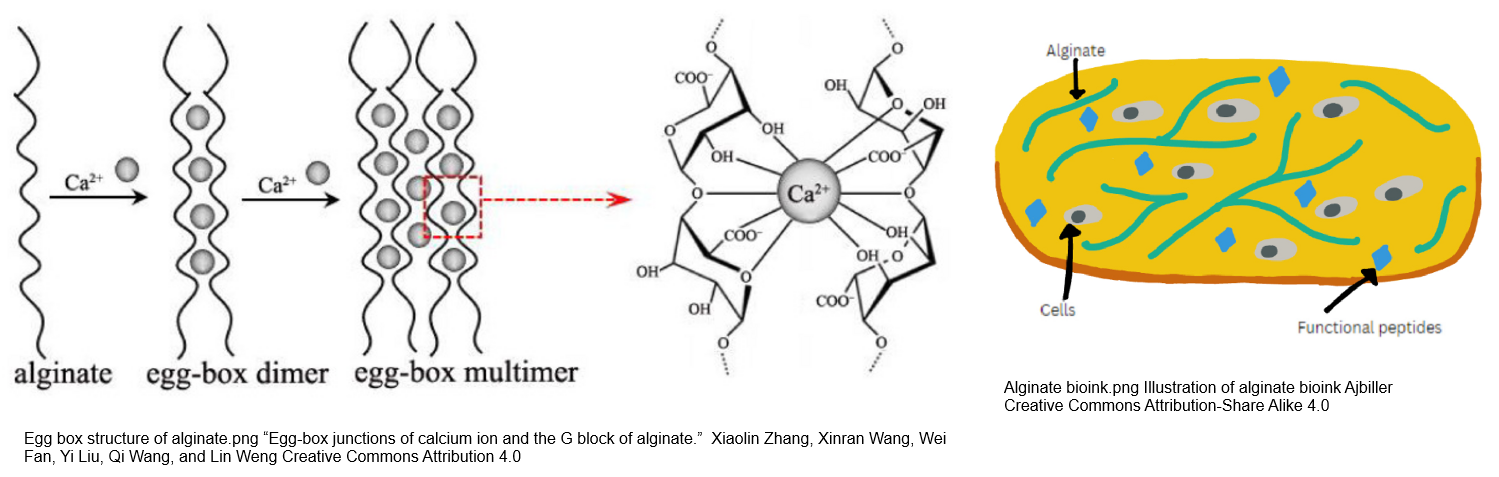
Let’s take a look at these molecular orbitals superimposed on the eggbox structure of Ca2+ alginate, only with the Ca2+ removed.

Agulhon 2012 [1] claimed their results confirmed previous studies of the affinity of alginic acid for the divalent metal ions that included D and P block elements Pb2+ > Cu2+ > Cd2+ >Ba2+ > Sr2+ > Ca2+ > Co2+ > Ni2+ > Mn2+ > Mg2+, referencing Haug 1965 [2] This 1965 study looked at alginate from different species of algae and various divalent cations with different anion counter ions.
pH comments from a nice review [3]
The process of metal binding to alginate
This review divided binding into specific and non specific. Plazinski was mostly focused on carboxyl groups with limited mention of hdroxyl groups. One of the carboxylate oxygens interacts directly with the metal ion while the other participates in a hydrogen bond, the egg-box model. α-L-guluronate chains form the twofold screw helical structure stabilized by intrachain hydrogen bonding between the carboxylgroup and the \(OH)2 moiety of the neighboring residue. The intrachain hydrogen binding involving the carboxyl group ischaracteristic of the chain containing only α-L-guluronate residues,but not (in general) for the ‘mixed’ chains composed of bothguluronate and mannuronate units. Molecular dynamics simulations indicate [21–23] that the most stable calcium-alginate chain complexes are characterized by the direct contact of Ca2+ ion with two carboxylate oxygens. Short comings:
- Some of these computational predictions do not adequately predict biological force fields.
- There are differences between Ca2+, transition metals, and the P-blocks not mentioned in the Plazinski review. Molecular Dyanmics computer models are limited to alkali earths in which there is not any overlap between their and oxygen molecular orbitals. Covalent bonds have entirely different interaction energies.
- In case of all studied complexes with transition metal cations, the bidentate and unidentate binding types can be present. However, the unidentate binding always corresponds to slightly more-stable structures.
- Furthermore, the metal cations can link either to the carboxyl or to the hydroxyl oxygens, offering a large variety of stable structures (including parallel and antiparallel chain–chain arrangements).
The Plazinski review covered Cu2+. As we contemplate the transition metals and P-block metalloids we’ve got to realize the electrons in their little probability clouds available for bonding to carboxyl and hydroxyl groups may be different. “As shown by Crist et al. [50] freeenergy change for metal ion binding by algal biomass containing the carboxylate functional groups is linearly related to the free energy change of formation of the corresponding metal acetates. ” The review continues. The bottom line seems to be we just don’t understand everything.
pH effects
“pH is one of the most crucial factors influencing the efficiency of the metal ion biosorption process. It is able to change both the surface properties of the biosorbent and the metal ion form in the bulk solution. The former factor is usually modeled by assuming the effect of competition between metal ions and protons for the available binding sites or by the ion-exchange models, in which the binding of metal ion occurs by the reaction with protonated surface sites, accompanied by the release of proton(s). The competition between different ions can be mathematically formulated in terms of the Ideal Competitive Adsorption Model(ICAM) or Non-Ideal Competitive Adsorption Model (NICAM)[53]. The increase of pH influences positively the metal binding efficacy(providing the metal is in the cationic form) up to higher pH values when the metal uptake starts to decrease (usually at pH > 8).”
Ionic strength effects
If we are trying to absorb Pb2+ from ingested food before it gets absorbed, Pb2+ has a few hurdles to get past that include anions and cations that might be loosely associated with the Ca2+-alginate Donnan surface. Peptides and amino acids from digested proteins in the stomach might also have carboxyl groups from aspartic and glutamic acids as well as the carboxy terminus of the peptide ! Some comments from the Plainski 2013 review:

- The spaces between the alginate polymers may be filled with waer and ions. It is assumed that the negative charges of eh carboyl groups are compensated by cations and H+. The cations may be non binding, just present in the gel volume.
- The larger concentration of cations shields the negative charge of the biopolymer network from the cation toxin to be absorbed. My the same token, anions like Cl- shield the heavy metals from the carboxyl groups of the alinate.
- The higher ionic strengthshields the attraction between the negatively charged gel network and the positively charged ions. It acts through the value of Donnan potential. The Gibbs-Donnan Effect describes the behavior of charged particles and proteins around a charged surface.
- The direct value of Donnan potential is possible to measure, but such measurements are rather rarely done
D and P block detox, trust experiments
The theory of alginate binding to D and P block elements is poorly study and very complicated. I seems it is best to trust the experiments.
References
- Agulhon P, Markova V, Robitzer M, Quignard F, Mineva T. Structure of alginate gels: interaction of diuronate units with divalent cations from density functional calculations. Biomacromolecules. 2012 Jun 11;13(6):1899-907 Sci-Hub free paper
- Haug A, Smidsrod A The Effect of Divalent Metals on the Properties of Alginate Solutions. II. Comparison of Different Metal Ions.Acta Chemica Scandinavica (1965) 19:341-351, free paper
- Plazinski W. Binding of heavy metals by algal biosorbents. Theoretical models of kinetics,equilibria and thermodynamics. Advances in Colloid and Interface Science 197–198 (2013) 58–67
- Tylkowski B, Jastrząb R. Smart Capsules for Lead Removal from Industrial Wastewater. Met Ions Life Sci. 2017 Apr 10;17:/books/9783110434330/9783110434330-004/9783110434330-004.xml. doi: 10.1515/9783110434330-004. PMID: 28731297. free chapter
Leave a Reply