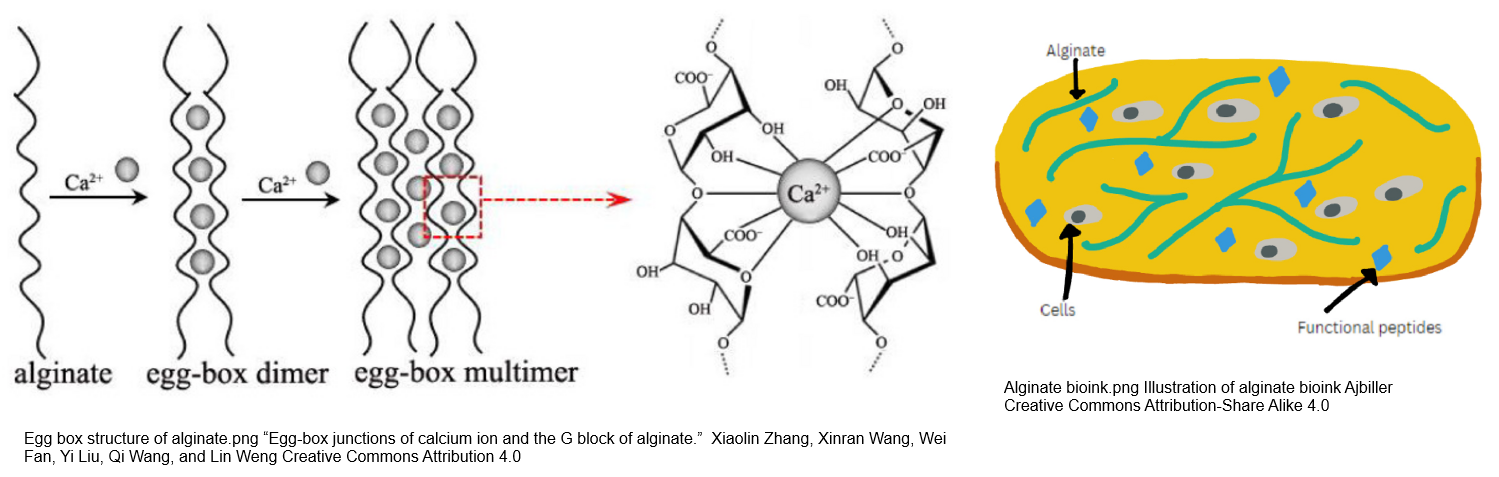
Calcium alginate gels are used extensively for dermal wound healing. This post includes excerpts from three vendors’ websites. PEMF is also used for wound healing. Could the two work together? I could not find any peer reviewed publications that I really liked. The structures I found for “egg box” Ca2+ alginate reminded me of gas-like electrons flowing around in electrical wires that respond to radio frequency PEMF. This post looks at Faraday’s Law of the Maxwell Equations. It certainly seems possible that PEMF can help Ca2+ alginate gels do what they do better. It is best to ask the experts that sell these gels what they think.
Maxell’s Equations
Faraday’s Law is perhaps the most important of the equations as it says that oscillating magnetic fields can exert a force on charged particles.

Gauss’s Law D is the electric displacement field and ρ or ρf is the free electric charge density. ∇ is a divergence operator illustrated in the cartoon below.
This is no one’s Law, or the law that says that magnetic uni-poles do not exist. One cannot separate the negative and positive poles of a magnet.
Faraday’s Law states that a magnetic field (B) that changes with time exerts a force on charged particles that induces them to move in a vector that is curled relative to the direction of the magetic field.
The Ampère–Maxwell Law states when an electric displacement field changes with time, the magnetic field intensity H is affected in vectors that curl around D once the free current density J is accounted for.
Adapted from Wikipedia page on Maxwell’s Equations
What exactly is meant by divergence and curl? As we move away from a point charge, the force decreases as indicated by lighter blue arrows. By convention, negative charges exert force lines towards them and positive force lines away from them. The right panels examine magnetic fields. A magnetic field coming out of the screen indicated by a circle wit a dot in it exerts a counter clockwise curling force on charged particles.

So what happens to the Ca2+ cations when they come into the presence of an electromagnetic field? We know what happens to radiowave antenna when they come in contact with radio frequency PEMF: the electrons start moving.

B is the direction of the magnetic field. The direction of tradition flow of current, I, is opposite from the flow of electrons. LibreText Physics Section 9.5: Free Electron Model of Metals. “Metals, such as copper and aluminum, are held together by bonds that are very different from those of molecules. Rather than sharing and exchanging electrons, a metal is essentially held together by a system of free electrons that wander throughout the solid. The simplest model of a metal is the free electron model. This model views electrons as a gas….The allowed wave functions describing the electron’s quantum states can be written as…where Lx, Ly, and Lz are positive integers representing quantum numbers corresponding to the motion in the x-, y-, and z-directions, respectively, and , and are the dimensions of the box in those directions. ..” The three dimesnonal qualities of electrons moving around in metals conjurs memories of Maxwell’s equations. Without getting into the quantum mechanics of electrons moving around in metals, it is pretty clear that Ca2+ moving around in an alginate matrix is a bit different.
Alginate
Ca2+ in alginate is different from electrons wandering through protons in a solid metal. In chemistry we learned that -COO– is the conjugate base and -COOH the conjugate acid. We can imagine H+ flowing through the alginate structure sort of line electrons flow through metals. H+ flows around the structure leaving “bases” and making acids. Ca2+ prefers to bind to the conjugate base -COO– for charge related reasons.

Let’s move on to what three different companies that market calcium alginate for wound care have to say about their products.
Three companies that sell calcium alginate
Vitality Medical
“Calcium Alginate Dressings for Wound Care
Calcium Alginate Dressings are a strong, versatile, and natural wound care dressing typically applied to diabetic wounds, venous wounds, full-thickness burns, split-thickness graft donor sites, pressure ulcers, cavity wounds, and chronic ulcers. They can also be used on dry wounds when combined with a sterile saline solution. Made from natural alginate fibers derived from brown seaweed, Calcium Alginate Dressings release calcium salts of alginic, mannuronic, and guluronic acids that, when combined with the sodium-rich fluids found in wounds, creates a reaction resulting in the formation of a soluble sodium gel. This natural gel helps to speed up the healing of the wound in promoting the wound’s autolytic debridement, while also absorbing excess fluid. Vitality Medical carries a wide selection of Calcium Alginate Dressings at some of the best prices around. Choose from top brands like 3M, Bertek Pharmaceuticals, Coloplast, ConvaTec, Covidien, Derma Sciences, Dermarite Industries, DeRoyal, Hartmann USA, Hollister, Johnson & Johnson, McKesson, MedLine, Safe N Simple, Smith & Nephew, and more.”
Why Choose Hollister Restore Calcium Alginate Silver Dressing?
- Effective antimicrobial agent against a broad spectrum of microorganisms
- Indicated for moderately to heavily exuding partial- and full-thickness wounds
- Effective against a broad spectrum of microorganisms over a period of up to 14 days, based on in vitro testing (which is beyond indicated wear time), including MRSA, VRE, and fungi
How To Use Hollister Restore Calcium Alginate Dressing?
Preparation of Wound Area
- Assemble supplies and take them to bedside
- Identify and inform the patient of the procedure
- Provide for privacy
- Wash hands and apply gloves
- Position the patient so that the wound area is exposed
- Thoroughly rinse or irrigate the wound area with Restore Wound Cleanser or normal saline, if appropriate. (If necessary, the wound should be debrided)
- Clean and dry the peri-wound skin
- Measure the wound using the wound measuring guide.
Application of Silver Alginate Dressing
- Apply Restore Calcium Alginate Dressing in Silver to cover the entire wound using an aseptic technique. The dressing may be loosely packed into undermining or tunneling
- Cover with appropriate secondary dressing using the aseptic technique (gauze, transparent film, etc)
- Secure secondary dressing with tape or other material
- Remove gloves and wash hands after completing the procedure.
Removal of Silver Alginate Dressing
- Wash hands and put on gloves
- Remove secondary dressing
- Remove restore calcium alginate dressing in silver. Residual pieces of the dressing may be removed from the wound base by irrigation
- Irrigate wound base using restore wound cleanser or normal saline, if appropriate
- Reapply to dress if necessary
- Remove gloves and wash hands after completing the procedure
Note: Restore Calcium Alginate Dressing, Silver may be left in place for up to four days. Dressing change frequency will depend on the patient’s condition and the level of exudate.
The website did not indicate if silver ions were involved in this process. Is this metallic silver that could be influenced by PEMF just as “gas like” electrons in metals are?
What is Calcium Alginate Dressing? The wound Pros
Definition and Composition:
Calcium alginate dressing is a highly absorbent wound dressing made from alginate, a natural polymer derived from the cell walls of brown seaweed. The primary components of this dressing are calcium and sodium alginate fibers, which are processed into a nonwoven fabric. These fibers form a gel when they come into contact with wound exudate, creating a moist healing environment.
Mechanism of Action:
The unique mechanism of action of calcium alginate dressing revolves around its interaction with wound exudate. When the dressing is applied to a wound, the calcium ions in the alginate fibers exchange with sodium ions in the wound fluid. This ion exchange process transforms the dry alginate fibers into a soft, moist gel. The gel formation has several beneficial effects:
Moist Environment: The gel maintains a moist environment at the wound site, which promotes cellular activities necessary for healing.
Absorption: Calcium alginate dressings can absorb up to 20 times their weight in fluid, making them highly effective for managing wounds with moderate to heavy exudate.
Debridement: The moist gel aids in autolytic debridement, a natural process where the body breaks down and removes dead or damaged tissue, facilitating the formation of new, healthy tissue.
Hemostasis: The calcium ions released during the gel formation process can help control minor bleeding by promoting hemostasis.
Benefits of Using Calcium Alginate Dressings:
Calcium alginate dressings offer several advantages, making them a preferred choice for various wound types:
Enhanced Healing: Calcium alginate dressings accelerate wound healing by maintaining a moist environment and supporting autolytic debridement.
Exudate Management: Their high absorbency helps to manage wound exudate effectively, reducing the risk of maceration and keeping the wound environment optimal for healing.
Comfort: The gel that forms in contact with wound fluid provides a soothing effect, reducing pain and discomfort associated with wound care.
Versatility: These dressings are suitable for a wide range of wounds, including pressure ulcers, venous ulcers, diabetic foot ulcers, surgical wounds, and traumatic wounds with moderate to heavy exudate.
Infection Prevention: Calcium alginate dressings can reduce the risk of infection and promote a cleaner wound site by effectively managing exudate and maintaining a moist environment.
Overall, calcium alginate dressings are an effective solution for managing complex wounds.
Next steps?
Maxwell’s equations and the chemistry of alginate have been covered. It sort of makes sense that PEMF would influence the movement of some charged particles, H+, Ca2+, or both, in alginate gels. I could not find evidence as to whether commercial PEMF devices can influence the wound healing properties of alginate gels. It is best to call the calcium alginate company gel reps before trying this yourself for safety reasons. Or just to get advice on keeping good notes!
Leave a Reply