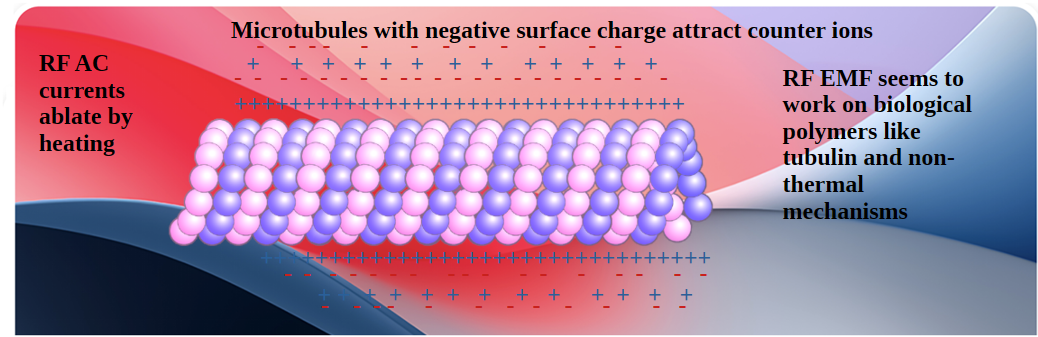
Radio frequency ablation uses radio frequency AC currents applied with a tissue inserted electrode. RF AC currents can generate RF electromagnetic fields in electrical wires via the “skin effect.” Current is most dense on the outside of the wire. This describes biopolymers like microtubules with their tubulin monomers (featured image). Radio frequency AC currents ablate tissue by heat generation. RF electromagnetic fields seem to have non-thermal means of killing killing cancer. Actin and microtubules are part of the cytoskeleton targeted by RF PEMF.
Radio frequency introduction
According to Wikipedia authors there are some weird properties of radio frequency AC electrical currents that can become PEMF
- “Electric currents that oscillate at radio frequencies (RF currents) have special properties not shared by direct current or lower audio frequency . e.g. the 50 or 60 Hz current used in the power grid.”
- “Energy from RF currents in conductors can radiate into space as electromagnetic waves (radio waves). This is the basis of radio technology.” So does RF ablation have some PEMF element? Doesn’t RF ablation just heat tissue up? What does it mean to be a conductor in tissue?
- “RF current does not penetrate deeply into electrical conductors but tends to flow along their surfaces; this is known as the skin effect.” Okay, does this have to do how long it takes charged particles that are not electrons to respond?
- “RF currents applied to the body often do not cause the painful sensation and muscular contraction of electric shock that lower frequency currents produce. This is because the current changes direction too quickly to trigger depolarization of nerve membranes. However, this does not mean RF currents are harmless; they can cause internal injury as well as serious superficial burns called RF burns.” So this means RF currents simply increase thermal motion, i.e. heat things up?
- “RF current can ionize air, creating a conductive path through it. This property is exploited by “high frequency” units used in electric arc welding, which use currents at higher frequencies than power distribution uses.”
- “Another property is the ability to appear to flow through paths that contain insulating material, like the dielectric insulator of a capacitor. This is because capacitive reactance in a circuit decreases with increasing frequency.” Reactance is resistance in this case. If the dielectric molecules are too large to re-orientate in a quickly changing field, no current gets through.
- “In contrast, RF current can be blocked by a coil of wire, or even a single turn or bend in a wire. This is because the inductive reactance of a circuit increases with increasing frequency.” This has to do with that opposition of an inductor to AC that arises from the fluctuating magnetic field.
- “When conducted by an ordinary electric cable, RF current has a tendency to reflect from discontinuities in the cable, such as connectors, and travel back down the cable toward the source, causing a condition called standing waves. RF current may be carried efficiently over transmission lines such as coaxial cables. “ So what about biological electrolytes and molecules? These are charged molecules in media that might not allow them to flow freely. If they cannot to they just experience friction and heat up?
the Skin Effect, not a Wikipedia rabbit hole
The Skin Effect simply says that current density is highest at the surface of a conducting material. This is due to magnetic field induction of eddy currents. As AC frequency increases, the current density increases towards tehe surface relative to the interior.

“Diagram of two adjacent wires carrying an alternating (AC) electric current (I, red arrows) in the same direction, showing the origin of proximity effect. Proximity effect is a redistribution of current in a AC current-carrying conductor, due to currents induced by the time varying magnetic field of an adjacent conductor from Faraday’s law of induction. In parallel wires carrying current in the same direction it causes the current to concentrate on the far side of the conductor, away from the neighboring conductor. It is caused by the magnetic field (B, green arrows) of the adjacent wire.
The drawing shows the currents and magnetic field at a point in the AC cycle when the current is increasing. The time varying magnetic field from the lefthand wire passes through the righthand wire, creating circular eddy currents (E) in the wire. “
“During the part of the AC cycle when the current is increasing the eddy currents circle in a clockwise direction as shown, increasing the current density on the right side of the wire (2) and decreasing the density on the left side (1).The resulting current density profile is shown by the red arrows, and color gradient on the cross section of the wire (3), with blue indicating lower current density, and green, yellow, and red progressively greater current density. During the other half of the cycle while the current is decreasing, the eddy currents are in a counterclockwise direction, reversing the current.”
Now imagine that these two wires are microtubules or other cytoskeletal elements. What about strands of DNA or even chromosome? These charged polymers will have a layer of counter ions that will conduct currents as per the skin effect.
Square RF AC waves ablate better
An J, Won DS, Park Y, Park JH, Park KH, Lee JH, Kim HS. Effects of changes in the waveform and frequency of radio frequency energy on tissue ablation range. PLoS One. 2024 Sep 19;19(9):e0308691. PMC free paper
Introduction
Yes, the charged particles/ molecules in the body vibrate, not move, in the direction of the RF AC. It is the friction of this movement that heats things up! Higher power means more current and a larger ablation range. If the impedance of the tissue is high, sometimes increased power does not increase the ablation range. Tissues were reported to “carbonize” as water evaporated thus preventing further current flow.
“ Theoretically, a square wave has higher energy than a sine wave at the same amplitude and frequency. Additionally, at lower frequencies, the energy transmission distance increases. We hypothesized that using a square wave and lower frequencies could increase the ablation range compared to the conventional method. Therefore, this study developed an RFA generator that can control the waveform and frequency. Variations in the ablation range of the tissues were observed according to the waveform, frequency, electrode type, and distance. “
Fig 1 I’m not going to get into the design of this device, but in the upper left hand corner, are some examples of inducers.

Fig 2 The authors used porcine hind limbs supplied by a butcher. Two types of electrodes, stent and needle, were used. The temperature was measured between the two electrodes. The important thing to note is they have placed two electrodes between two slabs of pork. This will become important in Fig 4.

Fig 3 shows the current/voltage relationships between sine and square waves at 10 and 500 kHz frequencies.

Fig 4 We are looking at cooked pork. The small insets show how much cooking occurred in the top and bottom slabs of pork on either side of the electrodes. Note that most cooking occurred between the electrodes. The distance between the electrodes was also varied. It is assumed that the output voltage and frequency were fixed at 45 V and 500 kHz, respectively.

Table 1 In experiments using the stent electrode, at an electrode distance of 10 mm, the square wave produced a significantly larger ablation area than the sine wave, with the sine wave producing an area of 91.3±8.4 mm2 and the square wave producing an area of 165.5±10.2 mm2 (p<0.001). A curious thing is that the authors reported an increase in temperature from 40oC to 70oC to go along with what looks like cooked pork.
Fig 5 It is assumed that the frequency is 500 Hz. This figure compares heating with the stent vs needle electrodes and sine vs square waves. Depth is also taken into consideration. The remarkable thing is how much faster tissue heats up with square waves. Intuitively, the shorter the electrode distance, the higher the temperature.


Table 2 Ablation ranges according to three frequencies, waveforms, and electrode type (M±SD, unit: mm2). In experiments using the stent electrode, the sine wave ablated a larger area at 100 kHz and 10 kHz compared to 500 kHz (p<0.01), For the square wave, a larger ablation area was formed as the frequency decreased (p<0.01) In this set of experiments withneedle electrodes, the sine wave only ablated regions around the electrode.
Fig 7 plots temperature as a function of time. The variables are electrode type, frequency, and wave form. As the frequency decreased, the temperature increased faster as the frequency decreased with the square wave than with the sine wave and with the stent electrode than with the needle electrode.

Slew rate is greater for the square waves. The impedance decreased when the tissue temperature increased. The high current flowed easily owing to the decreased impedance, resulting in the ablation of the center even with increased distance between the electrodes [7, 11]. In the experiment on frequency changes, the ablation range increased with low-frequency RF energy compared to that with high-frequency RF energy. In skin-depth studies of biological tissues, the energy transfer depth increased as the frequency decreased.
RF EMF, non-heating mechanisms
Dieper A, Scheidegger S, Füchslin RM, Veltsista PD, Stein U, Weyland M, Gerster D, Beck M, Bengtsson O, Zips D, Ghadjar P. Literature review: potential non-thermal molecular effects of external radiofrequency electromagnetic fields on cancer. Int J Hyperthermia. 2024;41(1):2379992. PMC free paper
Questioning the dogma that RF ablation operated via temperature increases, a literature review of the (3 kHz − 300 GHz) range was conducted.
“These effects span from mitotic arrest and growth inhibition to cancer cell death in the form of autophagyand apoptosis and appear to be mostly exclusive to cancer cells. Several cellular mechanisms were identified through which RF-EMF radiation potentially imposes its anti-cancer effects. Among those, by reviewing the included publications, we identified RF-EMF-induced ion channel activation, altered gene expression, altered membrane potentials, membrane oscillations, and blebbing, as well as changes in cytoskeletal structure and cell morphology. Conclusion: The existent literature points toward a yet untapped therapeutic potential of RF-EMF treatment, which might aid in damaging cancer cells through bio-electrical and electro-mechanical molecular mechanisms while minimizing adverse effects on healthy tissue cells. Further research is imperative to definitively confirm non-thermal EMF effects as well as to determine optimal cancer-type-specific RF-EMF frequencies, field intensities, and exposure intervals.”
Biological polymers like microtubules made of of tubulin subunits were some of the structures said to change in response to radio frequency electro magnetic fields in this review that covers non thermal mechanisms of radio frequency EMFs.
Microtubules are like transmission lines
This post is way too complicated to deep dive into in this post. It deserves its own post!
Mohsin M, Cantiello H, Del Rocío Cantero M, Marucho M. Electrical Oscillations in Microtubules. bioRxiv [Preprint]. 2025 Aug 29:2025.08.25.672199. PMC free paper
“Environmental perturbations and local changes in cellular electric potential can stimulate cytoskeletal filaments to transmit ionic currents along their surface. Advanced models and accurate experiments may provide a molecular understanding of these processes and reveal their role in cell electrical activities. This article introduces a multi-scale electrokinetic model incorporating atomistic protein details and biological environments to characterize electrical impulses along microtubules. We consider that condensed ionic layers on microtubule surfaces form two coupled asymmetric nonlinear electrical transmission lines. The model accounts for tubulin-tubulin interactions, dissipation, and a nanopore coupling between inner and outer surfaces, enabling luminal currents, energy transfer, amplification, and oscillatory dynamics that resemble the experimentally observed transistor properties of microtubules. The approach has been used to analyze how different electrolyte conditions and voltage stimuli affect electrical impulses’ shape, attenuation, oscillation, and propagation velocity along microtubules. Integrating transistor-like properties in the microtubules model has profound implications for intracellular communication and bioelectronic applications.”
Introduction tidbits
- Biopolymers like F-actin and DNA tend to be negatively charged. Positive counterions condense on their surface and move in response to applied electric fields in the form of ionic currents.
- The outer surface and lumen surface charges were discussed in the modeling of microtubules to powerlines.
- Unlike electrical wires, microtubules experience protonation and deprotonation as well as divalent cation binding.
a few images
- Fig 1 Theoretical soliton waves of ion movement in the lumen and surface of microtubules. They were apply physiological voltages and theoretical movement of counter ions. These are way too slow for RF.
- Fig 2, some other ion movements way too slow for RF.
- Fig 3 They isolated microtubules and applied some voltages and measured the frequency of soliton waves. They got a frequency around 40 Hz.
- Fig 10 shows the largely negative surface charge on microtubules. Red is negative and blue positive.
This is as far as this post is going to go into Mohsin, 2025, a rather complicated paper.
Concluding thoughts on RF AC and PEMF
- From the Wikipedia introduction to RF, the relationship between electricity and magnetism is complex in the radio frequency. Just AC can create a magnetic field via the skin effect that could be magnified by biological polymers that really have counter ion “skins.”
- An 2024 made a really good case for square RF waves heating more than sine RF ways. They never once mentioned the “slew rate”, or the rate of change of input energy. PEMF device companies are concerned with slew rates. Slew rate and ICES summarizes work of Robert Dennis of Micro-Plulse.com.
- I hypothesized that RF AC heats tissues up by forcing charged particles to move over the also charged surfaces of proteins and DNA faster than they want to move. No response was received from the corresponding author of Mohsin 2025 regarding this possibility.
- While the Dieper 2025 review made a good case for RF PEMF fighting cancer by means that do not require heating of the bulk tissue or solution, I speculate that heating of small regions might be sufficient to do something. Here is a quote from Libre Texts h “When an electron is promoted to an electronic excited state, it often ends up in an excited vibrational state as well (Figure 15.1.4 ). Vibrational energy, however, is not exchanged exclusively by means of photons. It can be gained or lost through molecular collisions and heat transfer.”
There is so much I do not fully understand about radio frequency pulsed electromagnetic frequencies! Diving into radiofrequency alternating electrical currents just made me realize how complicated biological systems are!
Leave a Reply