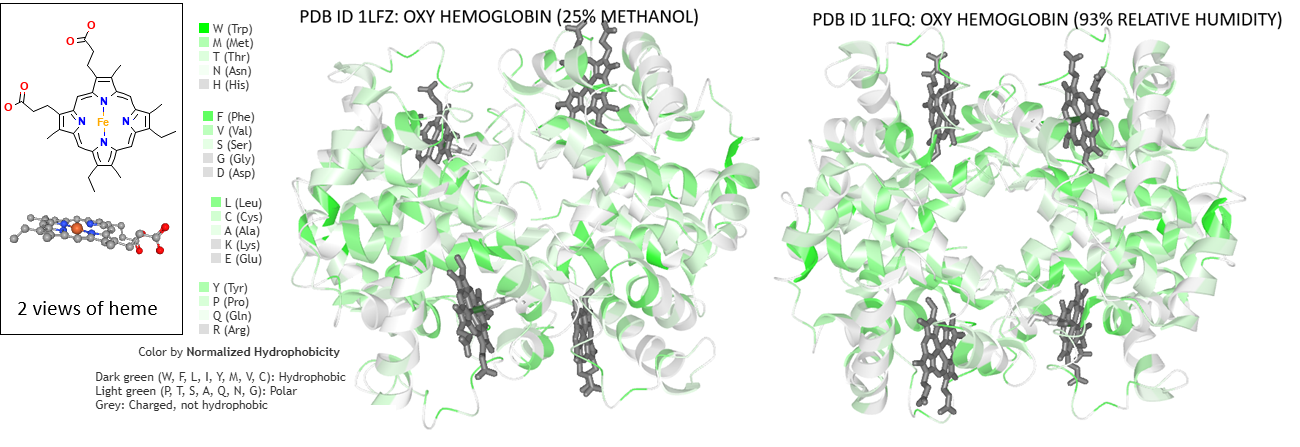
PEMF is said to increase oxygen delivery to our bodies. Just exactly what does this mean? Mayda 2020 performed an in silico study to ask if anything in the heme group could respond to magnetic fields. Yes, of course, that would be a d-shell electron of the iron. O2 diminishes the magnetic moment that can be felt by pi electrons in the porphyrin ring. Muehsam 2013 looked at the ability of a commercial static and radio frequency pulsed magnetic field devices. They found that both could coax heme to release O2. Wait! Going back further in time we find that Mousavy 2009 performed a classical protein biophysics study on radio frequency PEMF coming from a cell phone. They looked at O2 binding too. Yeah, the degree of saturation depends on the electric field strength measured on the opposite site of the tube with diluted blood. They found that PREMF can also pull in surface exposed hydrophobic regions of hemoglobin A making the protein more stable. This brings us to the featured image of two structures of hemoglobin crystalized under slightly different conditions. The green color scale is according to hydrophobicity. Some of these regions move in and out according to what’s goin on with a d-shell electron in a heme iron? Something to think about when one is exposed to non-thermal PREMF.
O2 binding to hemoglobin basics
Before getting to the featured papers we’ve got to do a quick study on the oxygen binding of hemoblobin. Teach Me Physiology does a good job of this. the percentage of oxygen bound to haemoglobin is related to the partial pressure of oxygen (pO2) at a given site. When oxyhaemoglobin reaches a tissue with a low pO2 (e.g. skeletal muscle), it will dissociate into oxygen and haemoglobin, resulting in an increase in local pO2. When it reaches a tissue that has a high pO2 (e.g. in the pulmonary circulation), haemoglobin will continue to take up more oxygen, resulting in a lowered pO2. Slide Share has a good piece on hemoglobin biochemistry. The featured image is slides 26 and 43 of 114 slides. 2,3-DPG/BPG destabilizes the deoxy T-form by creating more contacts for oxygen binding to Hb. O2 binding to Hb causes dissociation of 2-DPG because the cavity gets too small also favoring the R relaxed form. This particular slide share did not explain the spin paired and unpaired electrons.
Theoretical in silico predictions Mayda 2020
A search to discover what this means netted a Turkish paper describing magnetic nature of O2 binding to heme iron. These authors used computer simulations to show that local magnetic moments can develop in the porphyrin layer with antiferromagnetic coupling to the Fe moment. The focus was on d shell electrons of iron.
I’m including links to the figures because the are probably copyrighted.
- Figure 1 is a molecular diagram of hemoglobin A with the porphyrin group plus or minus oxygen that the authors used in their simulations.
- Figure 2. Magnetic-moment density. Compare the groups that have up and down magnetic moments and their relative intensities. It is interesting to note that the magnetic moment of the iron (Fe) is greater in the deoxy state.
- Figure 3 Bringing Temperature into the picture… Spin susceptibility depends on temperature. 37 oC can be converted to K by adding 273. Body temperature is 310K. The unpaired electron of the Fe electrons are more spin susceptible in the deoxy state.
- Figure 4 The authors introduced the concept of left and right polarized UV light. Biochemists tend to use the UV range of the visible spectrum to measure the concentration of compounds that have a lot of double bonds. with so called π electrons.
“This post will not attempt to understand the physics of electron spin coupling between d shell and π electrons. What we know about this physics predicts is that heme oxygen binding might be influenced by magnetic fields in vivo. Here is in vitro proof. When reading the next section, bare in mind the rather complex regulation of O2 binding to the hemoglobin tetramer, not just one of four heme groups. This is a fun paper to just scroll through the figures and marvel at how d shell electrons in the Fe of the porphyrin group might influence electrons i double bonds in the same group.
Muehsam 2013: pulsed radio EMF and astatic magnetic fields
It is rather difficult to communicate in this post just how exactingly the Muehsam study was in controlling conditions of exposure and the potential of heat generation, orientation side effects, and so on. Here are a few bullet points of what they did. One of the reasons the Muehsam study was so careful to control heating was because radio frequency ablation is use to heat and destroy tissue causing problems.
- All hemoglobin samples were exposed to the ambient magnetic field, which was measured using a digital Gauss/Tesla meter (model 7010, F.W. Bell, USA) to be 40.5±2 µT, 59 degrees from horizontal (vertical component = 34.7±2 µT, horizontal component = 21.0±2 µT).
- The FDA approved pulsed radio frequency PRF signal consisted of a 27.12 MHz sinusoidal carrier through pulse modulation in 4 ms bursts, repeating at 5 Hz and peak magnetic field amplitude of 10±1 µT. (Roma3, Ivivi Health Sciences, San Francisco, CA, USA) The authors went into great detail as to the clinically approved use for pain management in humans and animals, the exact orientation of the hemoglobin samples, origins of the devices, and so on.
- Static magnetic field SMF exposure was delivered using circular permanent ceramic magnets constructed for therapeutic applications (Magnetherapy, West Palm Beach, FL, USA), and composed of compacted and sintered strontium ferrite (SrO-6(Fe2O3)), encased in plastic. The horizontal component of the magnetic field (perpendicular to the magnet surface) was 186±6 mT, a field strength similar to those commonly employed in therapeutic applications . Temperature changes were rigorously controlled.
EMF exposure was for 30 minutes. After 150 minutes deoxygenation of 100 µM Hb was carried out in 50 mM Hepes buffer (pH 7.2) using the reducing agent dithiothreitol (20 mM) at 22°C, and is characterized here by the passage of the spectrum from a two-peaked to one-peaked form. Figure 1 of ref [2] shows visible light absorption spectra from radio feq PEMF and static magnetic field treated hemoglobin compared with untreated hemoglobin with a peak at about 540 and 575 nm. These peaks are seen in oxy but not deoxy hemoglobin.
The figures….
- Fig 1 The visible light absorption spectrum of deoxyhemoglobin. The pulsed ratio frequency and the static magnetic field removed a peak at about 575nm.
- Fig 2 Pulsed radio frequencies do nothing to increase the transition to deoxy hemoglobin.
- Fig 3 Adding the denaturing agent urea only speeds rPRF O2 release up a little bit.
- Fig 4 Release of O2 really speeds up in a static magnetic field!
- Fig 5, an actual view of the hemoglobin.
The heme group is in so many biological molecules…
Mousavy 2009, hemogobin on cell phone PREMF
I like to use only public access publication in my post because I want my readers to follow my sources. You may obtain a copy of this paper by going to the PubMed like below and like on the publisher site. The paper is old enough to get a PDF version for free. This is a direct quote from the Materials and Methods
“Exposure of HbA to the RF 910 MHz and 940 MHz EMF were carried by a spiral antenna (frequency range: 800 MHz to 12 GHz) in a temperature controlled incubator in the shielded room of the Antenna Laboratory of the University of Tehran (see Fig. 1).If the sample is situated far from the antenna, it can be assumed that the incident signal is a plane wave. The electric field intensity(EFI) in the location of the sample has been measured using an E-field probe and a calibrated spectrum analyzer at 37.0 ± 0.1 ◦C.RF continuous wave without any modulation is generated by the HP 8657A signal generator. As the output power level of the signal generator is limited to 15 dBm (decibel referenced to mW), a high power Wicom Tech GSM amplifier is added to guarantee the power requirements. The HbA sample (3 mL of solution) in a polystyrene tube was exposed to the 910 MHz or 940 MHz EMF. Temperature was controlled to within ± 0.1 ◦C by the incubator manufactured by PERSSOJEN CO (Iran). The treated sample was matched with unexposed control which was kept in the same experimental conditions, except this was isolated in a 10-mm thickness aluminum sample holder with an aluminum cap. The cable carries the signal from the E-field probe to the spectrum analyzer, which has 2.5 dBm losses. Observed power by the spectrum analyzer (e.g., 21 dBm) shows that power on the sample is equal to 23.5 dBm or 233.87 mW. Assuming the dipole antenna(probe) has a resistance, with R = 50
Na2S2O4 + O2 + 2H2O ⇆ 2NaHSO3 +H2O2 How much sodium dithionite (SDT,Na2S2O4 ) it took to reduce O2 bound to HbA was used as an index of affinity. The concentration needed for 50% total reduction was used in calculation of α.
α= 100([SDT]50unexposed-[SDT]50exposed)/[SDT]50unexposed This one is tricky. If there’s no change, α is 0. The bigger α the moreRF decreases the affinity for O2 . If α is negative, RF is increasing the affinity for O2 .
- Fig. 1. A block diagram for exposing the HbA samples. The RF antenna comes in from the “east” of the cuvette containing the dissolve HbA. There’s an E-field detector on the “west” of the cuvette. They used a Cary Eclipse Varian Australia spectro fluorescence spectrophotometer implying that spectra were not collected simultaneously with exposure to RF.
- Fig 2 The amount of SDT to achieve 50% reduction in exposed was about 0.5mM in the exposed and about 0.65mM in the unexposed.
- Fig. 3. Time-dependence of the effect of 940 MHz with EFI of 77 V/m on HbA. Experimental conditions: [HbA] = 32
µM in 10 mM phosphate buffer, pH 7.4, at 37 ◦C. The error bars indicate of triplicate repeating experiments. Even after two hours, the decrease was about 12% α increases as RF exposure increases. - Fig. 4. The far-UV Circular Dichorism spectra of the HbA in 10 mM phosphate buffer (pH 7.4). CD spectra of the exposed (a) and unexposed (b) HbA at 940 MHz with EFI of 77 V/m for 1 h. The HbA concentration was 21 μM. The inset shows error bars of spectra fortriplicate repeating experiments and high reproducibility of measurements. CD is used for assessing secondary structures in proteins like α-helices and β-sheets. The spectra were very close suggesting no gross changes in secondary structure.
- Fig. 5. The visible CD spectra of the HbA at 37 ◦C. CD spectra of the exposed (a) andunexposed (b) HbA at 940 MHz, 77 V/m for 1 h. The HbA concentration was 11 μM dissolved in 10 mM phosphate buffer at pH 7.4. The error bars of spectra indicate triplicate of repeating experiments and high reproducibility of measurements. The Soret CD spectrum in the visible region of the elecromagetic is indicative of π electrons of Mayda 2020. π–π* transition of the heme chromophore, and this transition is influenced by the surrounding aromatic amino acids suggesting changes not only in the electronic state of the heme but also in its environment.
- Fig. 6. Fluorescence spectra of HbA in 10 mM phosphate buffer (pH 7.4) at37 ◦C. Unexposed (—) and exposed (- – -) proteins. Experimental conditions:[HbA] = 10.2 μM, 940 MHz of EFI = 77 V/m, and exposure time = 1 h. The error bars of spectra indicate of triplicate repeating experiments and high reproducibility of measurements. Tryptophan fluorescence spectroscopy. Trptophan is an aromatic amino acid, usually buried in the hydrophobic cores of proteins, that fluoresces in the UV region of the electromagnetic spectrum. When tryptophan is exposed to the aqueous external environment, solvent molecules quench the excited state and hence the fluorescence. This is exactly what was observed. However there was a blue shift of about 4nm in the maximum wavelength of fluorescence. A blue shift is generally indicative of the tryptophan moving to a more hydrophobic region in contradiction with the 1/3rd decrease in fluorescence. It was reasoned that the quenching was due to the tryptophan moving closer to the heme iron.
- . Fig. 7. Fluorescence spectra of ANS binding with exposed (- – -) and unexposed (—)HbA (excitation wavelength was 355 nm). The HbA concentration was 10.3 μM dissolved in 10 mM phosphate buffer (pH 7.4). The protein was exposed with 940 MHz,EFI of 77 V/m for 1 h at 37 ◦C. The error bars of spectra indicate of triplicate repeating experiments and high reproducibility of measurements. ANS is a fluorescent probe used to map out exposed hydrophobic patches in proteins. Fluorescence of ANS in exposed HbA is less than unexposed HbA suggestig that the untreated HbA has more hydrophobic patches exposed to solvent than the RF exposed HbA. RF exposure was proposed to lead to a more compact structure.
- Fig. 8. Time courses for aggregation of HbA in 10 mM phosphate buffer (pH 7.4) at60 ◦C. Exposed (a) and unexposed (b) protein. Protein (11.3 μM) was exposed to radiation (940 MHz, EFI = 77 V/m and exposure time = 1 h, at 37 ◦C) and measurements of absorbance at 360 nm was carried out at 60 ◦C. The error bars indicate triplicate repeating experiments and high reproducibility of measurements. Most proteins are not too happy at this temperature that is too hot for most humans to touch comfortably. The two groups tracked each other until about 175 minutes of heating at which time the unexposed HbA aggregated more. These results are i agreement with the ANS results suggesting RF creates a more compact structure..
- Fig. 9. Heat-induced denaturation of the exposed (- – -) and unexposed (—) HbA in 10 mM phosphate buffer (pH 7.4). Experimental conditions: [HbA] = 10.4 μM,940 MHz, EFI = 77 V/m, exposure time = 1 h and at 37 ◦C. Denaturation was monitored by change in absorbance at 280 nm with a heating rate of 0.5 ◦C/min. The inset shows first derivative of plots of A280 vs. temperature. The error bars were showed in the inset indicates of triplicate repeating experiments and high reproducibility of measurements. Like solids such as ice, proteins have melting temperatures. An abrupt change in the absorbance at 280nm can indicate a change from a rigid, well ordered structure to something floppy and unordered. The RF exposed HbA had a higher melting temperature. Two things are going on: (a) melting and (b) aggregation that are addressed in Fig 10a,b.
- Fig. 10. Thermal unfolding and aggregation of the exposed (- – -) and unexposed (—) HbA in 10 mM phosphate buffer (pH 7.4) monitored by CD and turbidity. (a) CD melting curves, 222 (T), recorded at 222 nm report on a-helical unfolding. The unfolding of RF exposed HbA occurs at a slightly higher remperature than the unexposed. (b) Turbidity (dynode voltage) melting curves, V (T), recorded at 222 nm report on the heat-induced increase in the particle size due to protein aggregation. Experimental conditions: [HbA] = 10.4 μM, 940 MHz, EFI = 77 V/m, exposure time = 1 h and at 37 ◦C. Circular dichroism and dynode voltage at 222 nm was obtained in temperature range 25–85 ◦C with a scan rate of 0.5 ◦C/min. The error bars indicate triplicate repeating experiments and high reproducibility of measurements
Is there a message in all of this?
I’d like to think there is. Some PEMF sorts like to think of the energy of PEMF as “charging up a battery.”
| α˛ ± S.D | EFI (V/m) | comment |
| −2.20 ± 0.70 | 21.7 | At a low electric field intensity, O2 saturation is increased |
| 13.46 ± 3.58 | 30.6 | At a slightly higher EFI we see “release” of O2 as per Muhsam 2009 |
| 16.46 ± 5.54 | 48.6 | 50% increase in the EFI and just a small increase in α. |
| 17.01 ± 2.45 | 77 | There does not appear to be a linear relationship between and EFI. |
I am not an expert in structural changes in hemoglobin A under any conditions. There are structures HbA structures under high salt crystallization conditions as well. Some where in the peer reviewed literature there must be structural studies using the biophysical techniques of Mousavy 2009. Glycation of hemoglobin is another variable! How does one achieve the EFI for O2 release while not going overboard and heating the tissue?
References
- Mayda S, Kandemir Z, Bulut N, Maekawa S. Magnetic mechanism for the biological functioning of hemoglobin. Sci Rep. 2020 May 22;10(1):8569. PMC free paper
- Mousavy SJ, Riazi GH, Kamarei M, Aliakbarian H, Sattarahmady N, Sharifizadeh A, Safarian S, Ahmad F, Moosavi-Movahedi AA. Effects of mobile phone radiofrequency on the structure and function of the normal human hemoglobin. Int J Biol Macromol. 2009 Apr 1;44(3):278-85. PubMed
- Muehsam D, Lalezari P, Lekhraj R, Abruzzo PM, Bolotta A, Marini M, Bersani F, Aicardi G, Pilla A, Casper D. Non-thermal radio frequency and static magnetic fields increase rate of hemoglobin deoxygenation in a cell-free preparation. PLoS One. 2013 Apr 12;8(4):e61752. PMC free paper
Leave a Reply