This post is about a study by a Brazilian PEMF device company called Magdent. Souza 2025 did a really nice job characterizing changes in biofilm bacteria on artificial tooth implants in response to PEMF. It quickly became impossible to even form a biochemical hypothesis as to how. This site has had a lot to say about nitrate reduction and so on. There is a connection between reductive production of nitric oxide, production, and synthesis of the bacterial second messenger cyclic di-GMP (C-di-GMP) This same second messenger is part of biofilm signaling. A Korean group established a nitrogen cycle biochemical mechanism of how the olive oil compound tyrosol inhibits biofilm formation. The use of tyrosol and PEMF to combat dental plaque biofilms is proposed.
Biofilms are bacteria and protective junk
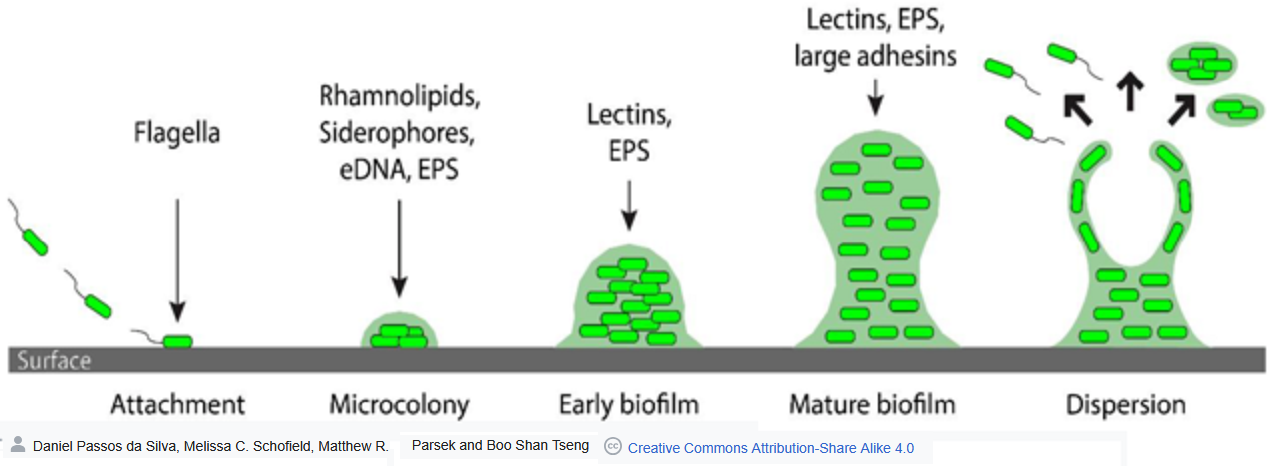
The feature image shows the interesting complexities of biofilms for those that think that PEMF works by the Faraday Law of Induction. Biofilms have
- extracellular DNA, a negatively charged polymer with positively charged cations surrounding it.
- Textracellular polysaccharides, which also tend to be negatively charged.
- Lectins are proteins that cross-link carbohydrates.
- Siderophores are proteins that bacteria use to bind soluble iron in the environment.
- Rhamnolipids are glycated llipids.
The MagDent study targeted the early stages of biofilm development. Much of the Introduction of this publication focused on previous studies showing pathogen killing. Their summary Fig 9 indicated that the hypothetical mechanism was one of killing rather than biofilm eradication.
It was somewhat difficult to discern a waveform from the description of the MagDent mini coil that has the purpose of preventing biofilms from growing on new artificial tooth implants. If we are simply getting counter ions moving in the film itself, other combinations may work.
- The electromagnetic field was activated within a 2 mm radius,
- exposure ratio of 1/500–1/5000,
- 10 and 50 kHz.
- average frequency estimated at 35.3 Hz using an oscilloscope.
- So if we have 10,000 cycles per second 1/500 =20Hz on average and 1/5000= 2 Hz. If we have 50,000 cycles per second 1/500= 100 Hz and 1/5000=10 Hz. This is very confusing, but the numbers sort of make sense.
- 0.05 to 0.5 mT,
- electromagnetic field for 30 consecutive days.
- exposure time is determined by the battery life,
- biofilm formation period (up to 72 h)
MagDent Study Figure Summary
- Fig. 1 shows nice cartoons of experimental protocols. There is an in vitro and in vivo (in the mouths of volunteers) aspects of this study. The only significant difference was a practical doubling of human salivary protein absorbed to the activated versus non activated pulse device. Saliva protein coating is assumed to be a good thing because we want this foreign device to resemble “self.”
- Fig. 2 examined corrosion resistance in artificial human saliva. We don’t want electronics rusting out in our mouths.
- Fig 3 Simulated human saliva was used to inoculate the implants. This figure shows the implant relative to the coils and some very nice scanning electron microscope images of the biofilm. The actual colony forming units (CFU) was about 10x. It is important to remember when looking at the graph that the units are are in exponential form.
- Fig. 4 bacteria counts in the biofilms of PEMF and control. Panel E is particularly interesting. PEMF reduced putative anaerobic pathogens Porphyromonas gingivalis (4x) and Tannerella forsythia (2x), while not changing Treponema socranskii.
- Fig. 5 PEMF decreased microbial diversity. One small change was reported in the Gram Rothia species relative abundance.
- Fig 6 shows species found only in the control group and only in the PEMF group. Discussion was presented as to the PEMF group increasing beneficial microorganisms and the control group harmful ones.
- Fig 7 looked at networks of microorganisms in control vs treatment. Which ones tend to occur together? Fusobacterium peridonticum ↔ Alloprevotella sp HMT30 were a two bug node in the control group. Rothia aeria ↔ Streptococcus oralis. were two bug networks in the PEMF group.
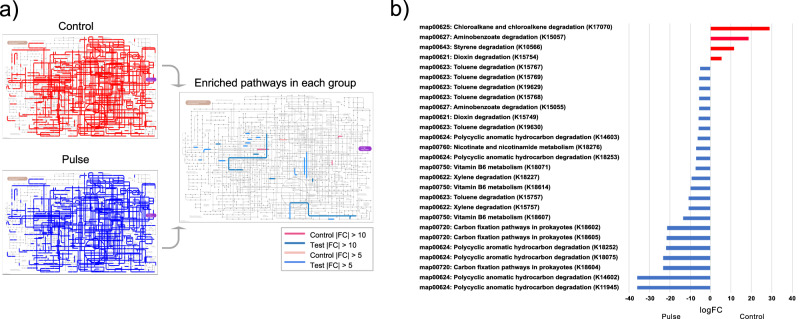
- Fig 8 looked at predicted KEGG pathways. Chloroalkene and chloroalkane pathway mRNA were enriched in the control and polycyclic aromatic hydrocarbon pathways were enriched in the PEMF. No pathways involving nitrate and/or fumarate reduction were mentioned.
Perhaps any PEMF device will have some influence on plaque/biofilm forming bacteria. Some practitioners might want to pay for a characterization if they buy into the notion of protective biofilm oral cavity bacteria.
A previous post on 5G PEMF and the gut microbiome suggests that PEMF might affect the Fe-S center transcription factor FNR that controls expression of fumarate and nitrate reductuctases when oxygen levels are low. There was nothing in the Souza 2025 study that stood out in this manner. The Assisi radio frequency PEMF device is claimed to generate nitric oxide via a very fine tuned Ca2+ calmodulin interaction while keeping the magnetic field intensity pretty low. Many of the very low frequency, higher magnetic field PEMF device companies are convinced that their PEMF devices achieve the same nitric oxide biochemical thing slightly differently. When it comes to nitric oxide production in bacteria it is an altogether different unknown.
Nitric Oxide, cyclic-di-GMP, and biofilms
Many very low frequency PEMF device manufacturers claim that their device stimulates better circulation via nitric oxide and cGMP production. Cyclic di-GMP is a second messenger involved in biofilm formation and all sorts of cell signaling. It’s production is very much linking to electron transport proteins that bacteria use to produce nitric oxide, the small molecule that turns on the production of c-di-GMP.
Animals and bacteria use a similar GTP derived second messenger
NO leads to the second messenger cGMP in humans. Bacteria use NO to activate production of their second messenger c-di-GMP. The arrow points to the “phosphodiester bond common to both second messengers. Phosphodiesterase cleaves this bond and destroys the messenger.

The differences in bacteria and animals is where the NO comes from.
Choi and Kim 2024, NO controls c-di-GTP coming and going
The very interesting thing about this story is that nitric oxide is the key to biofilm growth. (Choi and Kim 2024) On the surface this is counter intuitive. Diguanylate cyclase is an enzyme that makes the quintessential biofilm growth hormone C-di-GMP. Synthesis requires two GTPs. This enzyme has a very high affinity for nitric oxide, NO. Phosphodiesterase cleaves the phosphodiester bond that diguanylate cyclase created. PDE is activated by NO too. PDE’s affinity for NO is much lower. It is only when the concentration of NO is very high that PDE has a chance to undo the work of diGC. This is like a driver gaining fine control of their car by having one foot on the accelerator and the other on the brake.

Choi and Kim 2024, how bacteria make NO
NO, nitric oxide, is not a dead end. diGC must compete for NO with PDE and some other enzymes that take NO in different directions. Some of these enzymes might also be influenced by PEMF.

- NarGHJI, nitrate reductase has been covered already on this site. NarZYWV is NapABC is the periplasmic nitrate reductase
- NapABC contains Mo-molybdopterin guanine dinucleotide, one iron-sulfur cluster, diheme cytochrome c552 (NapB), and a tetraheme cytochrome c (NapC).
- NarZYWV , [4Fe-4S] centers, molybdopterin cofactor
- NirBB [2Fe-2S] centers
- NorV flavodoxin and rubredoxin like domains
- Hmp Binds 1 heme b (iron(II)-protoporphyrin IX) group per subunit, uses FAD+ 2 nitric oxide + NADPH + 2 O2 = 2 nitrate + NADP+ + H+ Note that this particular NO detox pathway is not anaerobic.
The take home message is that there are many unpaired electrons in these cofactors that might be acting and MagDent PEMF antennas. Most of the references are given for E coli. We do not know how many are present in the bacteria reported in the Souza 2025 study.
What the Choi and Kim 2024 study was really about
Tyrosol was discovered in an anti-biofilm screening of fungal products. Choi and Kim presented a lovely set of cartoons describing biofilm formation and how bacteria make NO. Tyrosol is found in olive oil. Many Internet sites like PetSafeKeeping claim that oilive oil in moderation is safe for dogs.

Delmopinol hydrochloride is a common ingredient in mouth washes. The nitrogen can be protonated, or not. If tyrosol is charged, or not, is is via the hydroxyl group on the benzene ring.
Sjödin T. The pH-dependent effect of cationic and non-ionic delmopinol on planktonic and biofilm bacteria. Arch Oral Biol. 2019 Jun;102:101-105. PubMed.
What does this mean for dog dental health?
The Assisi Dental Loop is currently only marketed for dental pain and accelerated healing. Ironically, the Assisi Loop Targets discussed nitric oxide production from Assisi activation of Ca2+-calmodulin that activates mammalian nitric oxide synthase. On the other hand, the magnetic fields of the Assisi products are far less than the MagDent device. Many vets are cool with their pet patients sleeping on PEMF mats and even targeted treatment with more powerful coils. Biofilms/plaque are a persistent problem for my squirmy dog that will not go along with tooth brushing.
Long ago vet: “Buy a tooth paste with biofilm degrading enzymes, rub it on the dog’s teeth, leave it there.”
Current vet a few years ago: “Give your dog OraVet chews with a biofilm fighting compound delmopinol.” Delmopinol is supposed to prevent bacteria from attaching to the teeth.
Current vet more recently: “Give your dog rawhide chews with biofilm degrading enzymes.”
Current vet last visit: “Your dog’s teeth are dirty.” Me, “I gave her the enzyme chews.” “What did we tell you the first time?”
Full disclosure: My dog is currently on the OraVet chews. I’m going this way because my dog doesn’t like me rubbing even flavored pastes on her teeth and does not much like chewing on rawhide.
Thoughts on Souza 2025 and Choi & Kim 2025 for pets
The Souza device is not meant to be a general oral hygiene product for humans or companion animals. It did a very nice job of prompting a search of the literature for pathways that lead to biofilm formation. While there are many reviews, Choi & Kim 2024 is particularly nice in that it does an excellent job of reviewing the literature and presents new data on a new inhibitory compound in a commonly available food product that is safe for companion animals in moderate amounts.
- Why not mix the enzymes available in a paste form with olive oil just to break up the proteins, lipids, and carbohydrates of the tartar/ biofilm? In the case of my dog, it’d have to be in the form of a chew.
- The tyrosol in the olive oil might turn off biofilm production in some of the bacteria.
- Maybe the vet approved PEMF mat or coils would simply facilitate of the mixing of the enzymes plus tyrosol. Maybe the PEMF would kill a few biofilm bacteria in the process.
- I will be looking into other mechanisms of action of delmopinol. My thought is that if delpinol gets into bacteria membranes (Rundegren 1995), PEMF is going to make it work better.
Talk to your dog’s or cat’s vet. In much of the research I have done, electromagnetic fields in PEMF devices approved for humans can harm some bacteria. If your pet is already using PEMF, it might be worth combining PEMF and vet approved oral health treatments. It will be a balancing act if your PEMF device is promoting the production of NO in your pet’s gums and/or biofilm/plaque bacteria.
References
- Choi HY, Kim WG. Tyrosol blocks E. coli anaerobic biofilm formation via YbfA and FNR to increase antibiotic susceptibility. Nat Commun. 2024 Jul 6;15(1):5683. doi: 10.1038/s41467-024-50116-3. PMC free paper
- Souza JGS, Azevedo F, Borges MHR, Costa RC, Shiba T, Barak S, Mayer Y, Figueiredo LC, Feres M, Barão VAR, Shibli JA. Microbiome modulation of implant-related infection by a novel miniaturized pulsed electromagnetic field device. NPJ Biofilms Microbiomes. 2025 Feb 26;11(1):36. PMC free paper
Leave a Reply