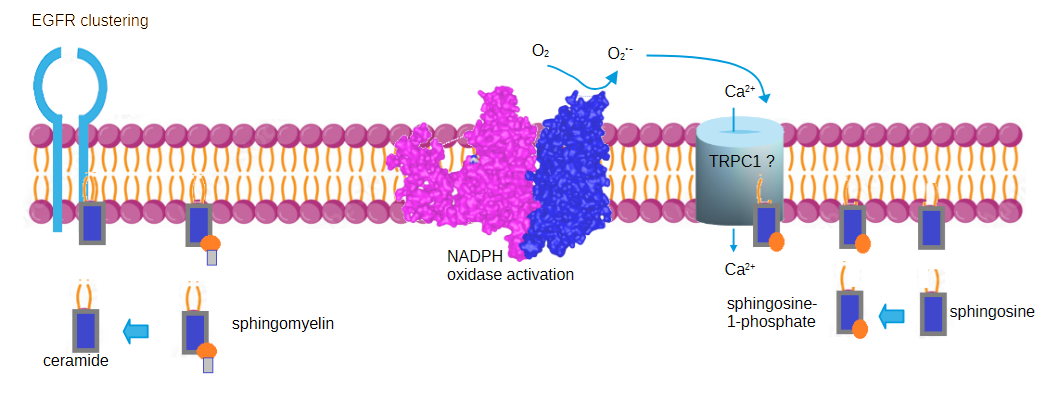
Unfortunately many publications referenced in this post are not public access. Many were obtained from Sci-Hub, whose public access is shaky. Three of the four reviewed publications come from Wen-Jun Sun’s laboratory in Zhejiang University School of Medicine, Hangzhou, ZJ, China. This journey starts with the notion that 50 Hz from powerlines contributes to leukemia via ceramides in lipid membranes. It does so via interaction of PEMF with voltage gated Ca2+ channels. Signaling kinases related to changes in intracellular Ca2+ were examined. Another kinase, Akt, was found to be the signaling kinase … and intracellular store operated Ca2+ channel the source of endogenous Ca2+release. Far from leukemia, this pathway is important in muscle stretch.
Ki 2008
Purpose: In a previous study, we found that exposure to a 50 Hz magnetic field (MF) could activate stress-activated protein kinase (SAPK) and P38 mitogen-activated protein (MAP) kinase (P38 MAPK) in Chinese hamster lung (CHL) fibroblast cells, and simultaneous exposure to a ‘noise’ MF of the same intensity inhibited these effects. In order to explore the possible target sites and upstream signal transduction molecules of SAPK and P38 MAPK, and further validate the interference effects of ‘noise’ MF on 50 Hz MF, the effects of MF exposure on clustering of epidermal growth factor (EGF) receptors and Ras protein activation were investigated.
Materials and methods: CHL cells were exposed to a 50 Hz sinusoidal MF at 0.4 mT for different durations, and clustering of EGF receptors on cellular membrane and Ras protein activation were analyzed using immunofluorescence confocal microscopy and co-precipitation technology. EGF treatment served as the positive control.
Results: The results showed that, compared with sham-exposed cells, exposure to a 50 Hz MF at 0.4 mT for 5 min slightly induced EGF receptor clustering, whereas exposure for 15 min enhanced receptor clustering significantly. Corresponding to receptor clustering, Ras protein was also activated after exposure to the 50 Hz MF. Exposure to a ‘noise’ MF (with frequency ranges from 30 – 90 Hz) at the same intensity and durations, did not significantly affect EGF receptor clustering and Ras protein. However, by superimposing the ‘noise’ MF, receptor clustering and Ras activation induced by 50 Hz MF were inhibited.
Conclusion: The results suggested that membrane receptors could be one of the most important targets where extremely low frequency (ELF) MF interacts with cells, and Ras may participate in the signal transduction process of 50 Hz MF. Furthermore, a ‘noise’ MF could inhibit these effects caused by ELF-MF.

We’re going to come back to this image later in our browsing of abstracts in this post. The two blue “open hands” could be any growth factor receptor that “clusters” only when both hands bind a growth factor. As for RAF, MEK, and ERK, a kinase is an enzyme that transfers a phosphate group from adenosine triphosphate (ATP) to a serine, threonine, or tyrosine amino acid side chain of a protein. Phosphorylation is a common way of turning enzymes on. Phosphorylation, transfer of a phosphate group, may also occur in lipids.
Qiu 2016
Purpose To investigate the effects of a 50-Hz magnetic field (MF) exposure on ceramide metabolism, as well as the cascade downstream signaling pathways in human amniotic (FL) cells. Materials and methods FL cells were exposed to MF at 0.4 mT for different durations (from 5-60 min). The ceramides levels were analyzed with high performance liquid chromatography tandem mass spectrometry (HPLC-MS/MS). The activity of cathepsin D was assayed using a fluorometric assay kit, and the activity of protein phosphatase 2A (PP2A) was examined by Western blotting. After exposing to MF at 0.4 mT for 60 min with sequential culture for different durations (0, 3, 6, 12 or 36 h), the rate of cell apoptosis was assessed by flow cytometry. Results Exposing cells to MF at 0.4 mT for different durations caused a significant increase in ceramide production via de novo synthesis and hydrolysis of sphingomyelin (SM), and the effect was different according to the exposure time. However, no significant change in cell apoptosis was detected after MF exposure for 60 min with sequentially culturing for up to 36 h. In addition, increase in ceramide did not activate its downstream signal molecules, cathepsin D and PP2A, which are usually closely related to apoptosis of cells. Conclusions Exposure to a 50-Hz MF could raise ceramide levels but had no significant effect on apoptosis in cultured cells.

Lipid rafts are rigid regions in the cell membrane enriched in cholesterol and “sphingolipids. ” Rafts tend to be hot zones of “signal transduction” of growth hormone receptors on the outside of the cell to intracellular kinases and other signaling enzymes that tell the nucleus to respond to changes in the environment. This is where the desire to look at sphingolpids came from.

These are two possible routes to increasing ceramides in the FL cells of Qiu 2016. These authors did not differentiate between de novo synthesis via sphingosine or the salvage pathway via sphinomyelin in this particular publication. Sphingosine kinase phosphorylates sphingosine to sphingosine-1-phosphate, a signaling molecule that modulates endogenous release of Ca2+ via TRPC1 stretch activated Ca2+ that are coupled to intracellular (endogenous) stores.
Feng 2018, ROS from NADPH Oxidase Nox
Purpose: A 50-Hz magnetic field (MF) was found to induce epidermal growth factor receptor (EGFR) clustering in our previous study. The aim of this work was to investigate the molecular mechanisms that mediated MF-induced EGFR clustering.
Materials and methods: Human amniotic epithelial (FL) cells were exposed to a 50-Hz MF. Total reactive oxygen species (ROS), cytoplasmic and mitochondrial superoxide production were detected by DCFH-DA, DHE and MitoSOX, respectively. EGFR clustering was analyzed using confocal microscopy after indirect immunofluorescence staining.
Results: Results showed that exposing FL cells to MF at intensity higher than 0.2 mT for 15 min enhanced total ROS production. Additionally, enhanced total ROS and cytoplasmic superoxide production were observed after exposing cells to MF at 0.4 mT for 5, 15, or 30 min, while mitochondrial superoxide production for 15 or 30 min. Pretreatment with Nox inhibitor, DPI, effectively inhibited MF-induced cytoplasmic superoxide production and subsequent EGFR clustering while mitochondrial superoxide production was not affected.
Conclusions: Nox-produced superoxide mediated a 50-Hz magnetic field-induced EGFR clustering.
Keywords: Epidermal growth factor receptor (EGFR); NADPH oxidase; magnetic field; reactive oxygen species.
Martinez 2021 confirmed these results using slightly different conditions: intermittent exposure to a 50-Hz, 100-µT sine wave magnetic field (MF) promotes human NB69 cell proliferation, mediated by activation of the epidermal growth factor receptor (EGFR) according to previous work by this group. The three mitogen activated protein kinase (MAPK) family members were explored in this publication: JNK, ERK1/2, and p38. This study favored the JNK, cell survival, pathway over the others. A summary figure can viewed at this link.
Sun 2018, 50 Hz ROS and acid sphingomyelinase
Purpose: Exposure to extremely low frequency electromagnetic fields (ELF-EMFs) could elicit biological effects including carcinogenesis. However, the detailed mechanisms by which these ELF-EMFs interact with biological system are currently unclear. Previously, we found that a 50-Hz magnetic field (MF) exposure could induce epidermal growth factor receptor (EGFR) clustering and phosphorylation on cell membranes. In the present experiment, the possible roles of reactive oxygen species (ROS) in MF-induced EGFR clustering were investigated.
Materials and methods: Human amnion epithelial (FL) cells were exposed to a 50-Hz MF with or without N-acetyl-l-cysteine (NAC) or pyrrolidine dithiocarbamate (PDTC). EGFR clustering on cellular membrane surface was analyzed using confocal microscopy after indirect immunofluorescence staining. The intracellular ROS level and acid sphingomyelinase (ASMase) activity were detected using an ROS assay kit and an Amplex® Red Sphingomyelinase Assay Kit, respectively.
Results: Results showed that exposure of FL cells to a 50-Hz MF at 0.4 mT for 15 min significantly enhanced the ROS level, induced EGFR clustering and increased ASMase activity. However, pretreatment with NAC or PDTC, the scavenger of ROS, not only counteracted the effects of a 50-Hz MF on ROS level and AMS activity, but also inhibited the EGFR clustering induced by MF exposure.
Conclusions: The present and previous data suggest that ROS mediates the MF-induced EGFR clustering via ASMase activation.
Keywords: 50-Hz magnetic field; acid sphingomyelinase (ASMase); epidermal growth factor receptor; reactive oxygen species (ROS).
Yang 2019
Previously, we found that exposure to a 50-Hz magnetic field (MF) could induce human amniotic epithelial (FL) cell proliferation and sphingosine kinase 1 (SK1) activation, but the mechanism was not clearly understood. In the present study, the possible signaling pathways which were involved in SK1 activation induced by 50-Hz MF exposure were investigated. Results showed that MF exposure increased intracellular Ca2+ which was dependent on the L-type calcium channel, and induced Ca2+ -dependent phosphorylation of extracellular regulated protein kinase (ERK), SK1, and protein kinase C α (PKCα). Also, treatment with U0126, an inhibitor of ERK, could block MF-induced SK1 phosphorylation, but had no effect on PKCα phosphorylation. Also, the inhibitor of PKCα, Gö6976, had no effect on MF-induced SK1 activation in FL cells. In addition, the activation of ERK and PKCα could be abolished by SKI II, the inhibitor of SK1. In conclusion, the intracellular Ca2+ mediated the 50-Hz MF-induced SK1 activation which enhanced PKCα phosphorylation, and there might be a feedback mechanism between SK1 and ERK activation in responding to MF exposure in FL cells.
Chen 2020
Extremely low frequency electromagnetic field (ELF-EMF) is a kind of physical stimulus in public and occupational environment. Numerous studies have indicated that exposure of cells to ELF-EMF could promote cell proliferation. But the detailed mechanisms implicated in these proliferative processes remain unclear. In the present experiment, the possible roles of sphingosine-1-phosphate (S1P) in 50-Hz magnetic field (MF)-induced cell proliferation were investigated. Results showed that exposure of human amniotic (FL) cells to a 50-Hz MF with an intensity of 0.4 mT significantly enhanced ceramide metabolism, increased S1P production, activated extracellular signal regulated kinase 1/2 (ERK1/2), and promoted cell proliferation. All of these effects induced by MF exposure could be inhibited by SKI II, an inhibitor of sphingosine kinase (SphK). In addition, both the cell proliferative response and the ERK1/2 activation induced by MF exposure were blocked completely by U0126, a specific inhibitor of MEK (ERK kinases 1 and 2). Taken together, the findings in present study suggested that S1P mediated 50-Hz MF-induced cell proliferation via triggering ERK1/2 signal pathway.
Ye 2022
The mechanism underlying the biological effects caused by an extremely low-frequency electromagnetic field (ELF-EMF) is still unclear. Previously, we found that L-type calcium channel and sphingosine kinase 1 (SK1) were involved in 50-Hz MF exposure-induced cell proliferation. In the present study, the role of intracellular Ca2+ and signal molecules related to SK1 in cell proliferation induced by 50-Hz MF was investigated in human amniotic epithelial (FL) cells. Results showed that the intracellular Ca2+ chelator, BAPTA, could completely inhibit 50-Hz MF-induced cell proliferation, whereas NIF, the inhibitor of L-type calcium channel, only partly blocked it. When cells were cultured in calcium-free medium, MF exposure also increased intracellular Ca2+, activated SK1 and promoted cell proliferation although all of those increasing levels were lower than those in complete medium. Moreover, MF-activated SK1 could be completely inhibited by BAPTA, and MF-induced cell proliferation was abolished by SKI II, the specific inhibitor of SK1. Additionally, a 50-Hz MF exposure did not affect the activation of ERK and PKCα under the condition of calcium-free medium, but activated the Akt, which could be precluded entirely by BAPTA, but not be inhibited by NIF. Treatment of FL cells with LY294002, the inhibitor of Akt, could delete the MF-induced SK1 activation under the condition of calcium-free medium. Based on the data from the present experiment, it is concluded that endogenous Ca2+ release was involved in 50-Hz MF-induced cell proliferation via Akt-SK1 signal cascade.
It should be noted that PKCα is activated by increases in Ca2+. The additional twist is that enzyme activity of sphingosine kinase (SK1), PKCα, and PKCα’s target ERK kinase were traditionally assumed to be turned on by phosphorylation. Antibodies against kinase specific phosphorylation sites were used to determine if these kinases had been turned on.
- Go6976 an inhibitor of protein kinase C alpha, PKC
- Nifedipine (NIF), an L-type Ca2+ channel inhibitor.
- U0126 in an ERK inhibitor. Extracellular signal-Regulated Kinases transfer phosphate groups to serine or threonine amino acid side chains upon activated (phosphorylated) when growth factors bind extracellular receptors.
- SKI II is a sphingosine kinase inhibitor that reduces levels of sphingosine -1-phosphate.
Note that nothing was said in the abstract as to where this endogenous Ca2+ comes from if it is not through L-type voltage gated Ca2+ channels.
Formigli 2009, sphingosine-1-phosphate and Ca2+
Transient receptor potential canonical (TRPC) channels provide cation and Ca(2+) entry pathways, which have important regulatory roles in many physio-pathological processes, including muscle dystrophy. However, the mechanisms of activation of these channels remain poorly understood. Using siRNA, we provide the first experimental evidence that TRPC channel 1 (TRPC1), besides acting as a store-operated channel, represents an essential component of stretch-activated channels in C2C12 skeletal myoblasts, as assayed by whole-cell patch-clamp and atomic force microscopic pulling. The channel’s activity and stretch-induced Ca(2+) influx were modulated by sphingosine 1-phosphate (S1P), a bioactive lipid involved in satellite cell biology and tissue regeneration. We also found that TRPC1 was functionally assembled in lipid rafts, as shown by the fact that cholesterol depletion resulted in the reduction of transmembrane ion current and conductance. Association between TRPC1 and lipid rafts was increased by formation of stress fibres, which was elicited by S1P and abolished by treatment with the actin-disrupting dihydrocytochalasin B, suggesting a role for cytoskeleton in TRPC1 membrane recruitment. Moreover, TRPC1 expression was significantly upregulated during myogenesis, especially in the presence of S1P, implicating a crucial role for TRPC1 in myoblast differentiation. Collectively, these findings may offer new tools for understanding the role of TRPC1 and sphingolipid signalling in skeletal muscle regeneration and provide new therapeutic
Is NADPH oxidase the 50 Hz antenna?
This image was generated from NCBI/structure. Cui 2024 is the associated publication. No, PEMF was not covered as one of the regulators of regulators. Not shown in this structure are the Ca2+ binding to the EF-hand domains that permits electron transfer between NADPH and FAD and superoxide production. They found a Zn2+ binding motif too. These authors looked at three different states
- Pre-reaction state (NADPH-bound without Ca2+), Do we assume that FAD is here all along? Fig 3 has FAD in close proximity with the inner heme. It is so tempting to speculate that 50 Hz is interacting with one or both of those functional groups.
- Intermediate states (in the presence of NADPH and Ca2+) No pretty cartoons of the Ca2+ EF hands. Fig 5 does have nice scheme of how Ca2+ binding triggers conformational changes in the NADPH and FAD binding domains.
- post-reaction state (with NADP+ and Ca2+) The electron of NADPH naturally going to O2, electron transfer from the outer heme.

We have ourselves a chicken and the egg conundrum. Which came first: PEMF activating Ca2+ entry from TRPC1 stretch activated channel, voltage gated L-type, or whatever? PEMF activation of Nox5 could generate superoxide that opens TRPC1 and related redox sensitive channels. Cui 2024 mention lipid sensitivity of Nox family members from other species in their discussions. The ceramide family is another twist of what appears to be a complicated relationship.
References
- Chen L, Xia Y, Lu J, Xie Q, Ye A, Sun W. (2020) A 50-Hz magnetic-field exposure promotes human amniotic cells proliferation via SphK-S1P-S1PR cascade mediated ERK signaling pathway. Ecotoxicol Environ Saf. 2020 May;194:110407. PubMed
- Cui C, Jiang M, Jain N, Das S, Lo YH, Kermani AA, Pipatpolkai T, Sun J. (2024)Structural basis of human NOX5 activation. Nat Commun. 2024 May 11;15(1):3994. PMC free paper
- Feng B, Dai A, Chen L, Qiu L, Fu Y, Sun W. (2018) NADPH oxidase-produced superoxide mediated a 50-Hz magnetic field-induced epidermal growth factor receptor clustering. Int J Radiat Biol. 2016 Oct;92(10):596-602. PubMed
- Formigli L, Sassoli C, Squecco R, Bini F, Martinesi M, Chellini F, Luciani G, Sbrana F, Zecchi-Orlandini S, Francini F, Meacci E. (2009) Regulation of transient receptor potential canonical channel 1 (TRPC1) by sphingosine 1-phosphate in C2C12 myoblasts and its relevance for a role of mechanotransduction in skeletal muscle differentiation. J Cell Sci. 2009 May 1;122(Pt 9):1322-33. sci-hub free paper
- Ke XQ, Sun WJ, Lu DQ, Fu YT, Chiang H. 50-Hz magnetic field induces EGF-receptor clustering and activates RAS. Int J Radiat Biol. 2008 May;84(5):413-20. Sci-Hub free paper
- Martínez MA, Úbeda A, Trillo MÁ. (2021) Role of NADPH oxidase in MAPK signaling activation by a 50 Hz magnetic field in human neuroblastoma cells. Electromagn Biol Med. 2021 Jan 2;40(1):103-116. free paper
- Qiu L, Feng B, Ni Z, Wu X, Sun W. (2016) Exposure to a 50-Hz magnetic field induced ceramide generation in cultured cells. Int J Radiat Biol. 2016;92(4):215-21. Sci-Hub free paper
- Sun L, Chen L, Bai L, Xia Y, Yang X, Jiang W, Sun W. (2018) Reactive oxygen species mediates 50-Hz magnetic field-induced EGF receptor clustering via acid sphingomyelinase activation. Int J Radiat Biol. 2018 Jul;94(7):678-684. PubMed
- Yang X, Ye A, Chen L, Xia Y, Jiang W, Sun W. (2019) Involvement of calcium in 50-Hz magnetic field-induced activation of sphingosine kinase 1 signaling pathway. Bioelectromagnetics. 2019 Apr;40(3):180-187. Sci-hub free paper
- Ye AF, Liu XC, Chen LJ, Xia YP, Yang XB, Sun WJ. Endogenous Ca2+ release was involved in 50-Hz MF-induced proliferation via Akt-SK1 signal cascade in human amniotic epithelial cells. Electromagn Biol Med. 2022 Apr 3;41(2):142-151. PubMed
Leave a Reply