This post starts with an introduction of MagnaWave PEMF to treat hoof abscesses. Blood supply to the hoof is introduced. The reader is directed to additional resources. The MagnaWave process is introduced. The reader is directed to a paper of care for equine/bovine foot infections. Then we return to the blood supply and the myogenic tone that controls blood flow. Yes, some of the ion channels that control myogenic tone are reported to be influenced by PEMF. This post is intended to be a conversation starter between practitioner and veterinarian.
Blood supply to the equine foot
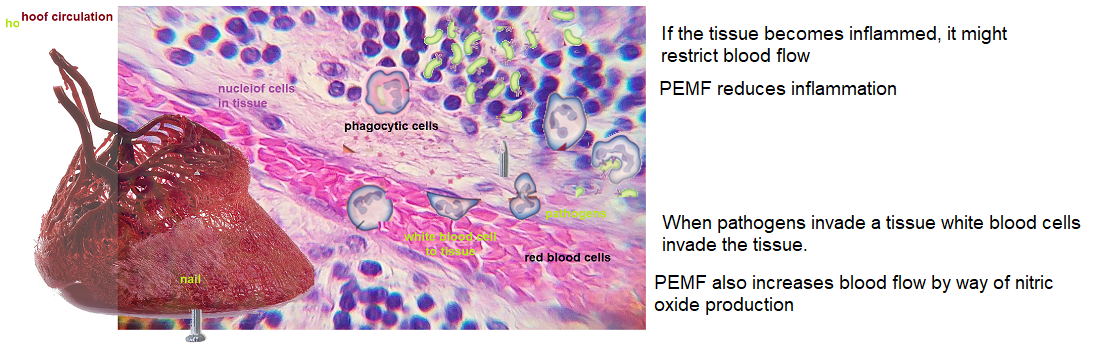
The featured image is derived from a sculpture of horse hoof Blood vessels Sculpture by Christoph Von Horst. A WikiCommons image of a small blood vessel or capillary has been embellished with white blood cells migrating belong the vessel and into the tissue where they take care of the pathogens. Lindsey Field has a great YouTube video on the blood supply of the equine foot. In this video Dr .Fields goes over a section of a foot that she was going to embed in epoxy but decided to first make a video showing the viewer little holes where blood vessels were once. When a horse has an infection, these vessels are compromised.
Hoof Abscess, the MagnaWave narrative
If your horse is suffering from hoof abscesses, MagnaWave may help expedite the healing process.

from Wikipedia Commons Pink: skin and soft tissues Brown: walls Light gray: bones (navicular bone and coffin bone) Red: walls and sole living chorium Dark gray: frog Orange: toe sole Yellow: digital cushion Cyan: tendons (extensor, front; deep palmar flexor, back)
Abscess Definition
An abscess is an accumulation of pus (which are simply dead white blood cells) that have formed a lump internally or externally on the horse’s body. An abscess occurs as a result of an infection. Abscesses can begin with a wound, a nail in the hoof, strangles, or penetration of the skin with a foreign object. The accumulated white blood cells become encapsulated as the body works to isolate the infection, in turn forming an abscess.
MagnaWave uses PEMF technology to essentially stimulates good oxygenation, better blood flow to the body, in turn, allowing it to heal itself.
Some symptoms of hoof abscesses may include:
- Pain due to pressure
- Lameness
- Secretion of pus
- A firm lump that may be tender or hot
- Slight swelling at the sight
PEMF for your horse’s abscess is non-invasive, requires no downtime, is chemical free and has no side effects.
Redding & O’Grady 2012 Hoof Infection Standard of Care, ⚕️
Redding WR, O’Grady SE. Septic diseases associated with the hoof complex: abscesses, punctures wounds, and infection of the lateral cartilage. Vet Clin North Am Equine Pract. 2012 Aug;28(2):423-40. Sci-Hub free paper
Redding and O’Grady have done a really good job of explaining many of the standard of care protocols for hoof infections of one kind or another. They have many detailed photographs and address the issue of nails and other invading debris as the source of pathogens. Many of these protocols are very invasive and not so economical If PEMF increases blood flow and oxygenation even to the foot, PEMF might be a good first line of attack once a veterinarian has been consulted. Many of the anatomy terms are explained in this link:
Horse Foot Anatomy
The above link will send the reader to a rather amazing British Vet Med site that addresses the anatomy of the equine foot. The following are highlights from the very informative page.
- There is a disease called white line disease that can involve bacterial and/or fungal infections.
- The collateral groove runs along either side of the frog.
- The frog is composed of thick, leathery material. and is vulnerable to infections if unhealthy. The frog also protects sensitive structures beneath, providing traction, assisting circulation and absorbing shock. It also contains many nerves afferent nerves that aid in proprioception.
- The central sulcus, towards the back of the hoof, should be wide and shallow. If the frog is weak and narrow it can become a deep crease is prone to bacterial and fungal infections.
- The hoof is heavily supplied with blood through the two arteries which run down the back of the leg and into the foot. The pedal bone itself has an unusually high density of blood vessels within it. The blood pumping around the foot has many vital uses. It supplies nutrients to allow growth of new horn tissue, assists with damping impact shock and helps to regulate hoof temperature.
Myogenic tone
Quick review, horse foot study
Brosnan RJ, Steffey EP, Esteller-Vico A, Vaughan B, Liu IK. The relationship between digital perfusion pressure and hoof lamellar blood flow in isoflurane-anesthetized horses. Res Vet Sci. 2011 Feb;90(1):138-45. Sci-Hub free paper
This study used fluorescent microbeads to measure blood flow through the hoof in anesthetized horses. Trigger alert: these horses were killed after the study and their feet removed for analysis. This study has done an excellent job of reviewing the literature. For instance, the pressures on blood vessels of recumbent horses are not the same as those moving around. The authors cited references of neurohumoral factors also influence the relaxation/contraction of blood vessels in the hoof. Many of these may be present in infections: nitric oxide, prostacyclin, and prostaglandins E1 and E2 and cause vasodilation. Other neurohumoral factors may cause vaso constriction. Myogenic tone was mentioned a lot.
The Bayliss effect, a Wikipedia fact checking journey
The Wikipedia authors usually do an excellent job of reviewing peer reviewed literature. Vascular tone. is pretty good but is somewhat of a rabbit hole from this post. The Wikipedia page of myogenic tone or the Bayliss effect, discusses voltage gated and stretch activated Ca2+ channels. Stretch activated chloride channels are also mentioned. In this way is separate from neurotransmitter controlled neurogenic tone.
- Beech DJ. Emerging functions of 10 types of TRP cationic channel in vascular smooth muscle. Clin Exp Pharmacol Physiol. 2005 Aug;32(8):597-603. PMC free paper TRPC2 is more myogenic tone. Not sure if TRPC2 is activated by PEMF
- Doughty JM, Miller AL, Langton PD. Non-specificity of chloride channel blockers in rat cerebral arteries: block of the L-type calcium channel. J Physiol. 1998 Mar 1;507 ( Pt 2)(Pt 2):433-9. PMC free paper “increased chloride conductance may depolarize pressurized vessels and so modulate the myogenic response is an attractive one for which there is a lot of circumstantial evidence. However, although a range of chloride channel blockers is available, their usefulness as diagnostic tools for the evaluation of the role played by chloride conductances in the myogenic response is hampered by their lack of specificity in the cerebral vasculature.”
- Jackson WF. Myogenic Tone in Peripheral Resistance Arteries and Arterioles: The Pressure Is On! Front Physiol. 2021 Jul 22;12:699517. PMC free paper This is an excellent review that backs up the Wikipedia unreferenced claims. Included are voltage gated calcium and potassium channels and TRPC family members. Strain to the cytoskeleton is also mentioned. Also see PEMF and TRPC1 and PEMF and VGCC on this site.
Conclusion
Everything MagnaWave says about abscesses fact checks out, except for the utility of PEMF, which is untested ground in the peer reviewed published literature. The blood flow to the horse hoof suggests that it originates internally from the vascular smooth muscle cells themselves, i.e. myogenic. Many of these channels have been shown to be modulated by PEMF. It is hoped that this post serves as a talking point between practitioner and veterinarian to give PEMF a try as a first line of therapy for a hoof abscess.
Leave a Reply